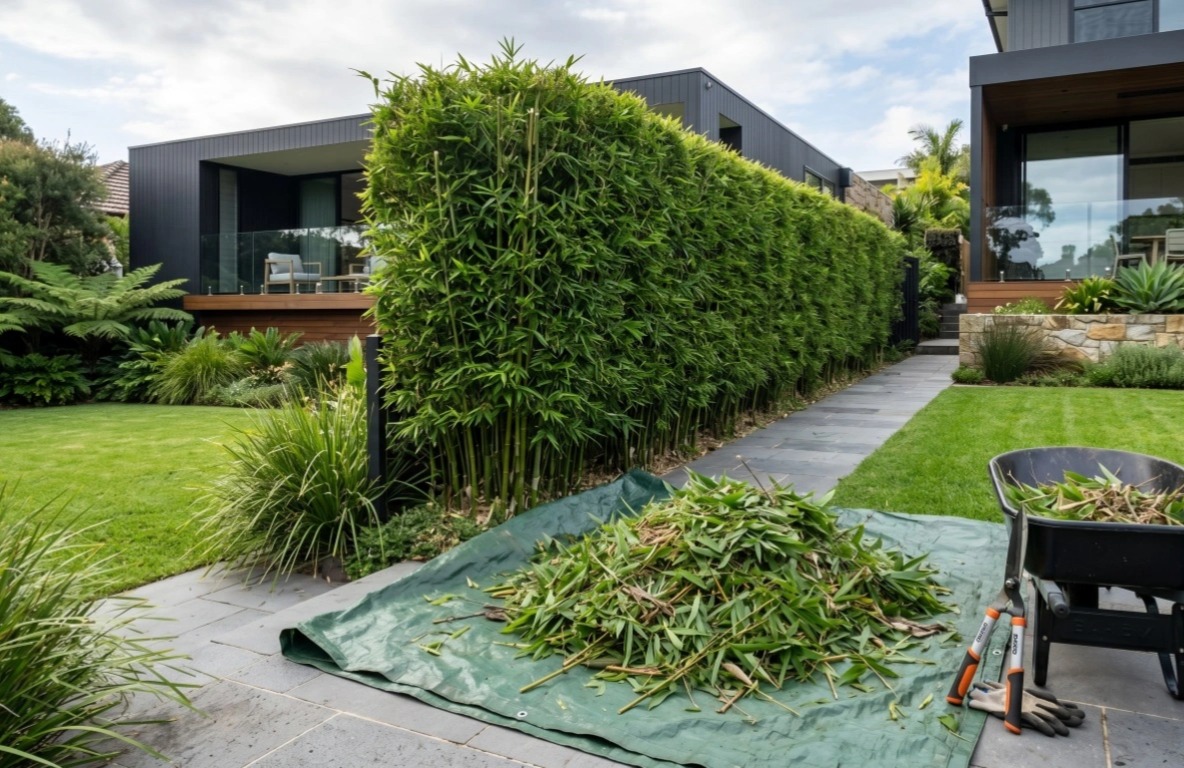
Running vs Clumping Bamboo: How to Tell What’s Actually in Your Garden
Most people only find out which type they’ve got after it’s already crossed a fence line. Here’s the five-minute test we use in the field, the species that actually cause trouble in Sydney, and what to do once you know.
✓ Sydney species guide
✓ What actually spreads
✓ When to call a pro
Running bamboo spreads through underground rhizomes and can travel metres in a single growing season, popping up wherever it pleases — including your neighbour’s garden, under paving, or through a fence line. Clumping bamboo stays in one expanding mass at the base of the original plant and is the only type that’s genuinely safe to plant near a boundary. You can usually tell which one you’ve got in about five minutes without digging anything up — we’ll show you how below.
Bamboo is one of those plants that gets a bad reputation it doesn’t always deserve. Plenty of bamboo in Sydney gardens is doing exactly what its owner wanted — screening a balcony, blocking a sightline, adding a bit of green privacy without taking up much ground space. The trouble only starts with one specific type, and most people who plant it have no idea which type they’ve actually got until something goes wrong.
This isn’t really a plant identification problem. It’s a “which one of these two completely different growth habits am I dealing with” problem, and once you know the answer, everything else — whether you need to worry, what it’ll cost to sort out, whether your neighbour has a legitimate complaint — falls into place pretty quickly.
So we’re going to skip the botanical Latin lecture and just show you how to tell, using the same checks we run through on a site visit.
After enough years pulling rhizomes out of Eastern Suburbs gardens, here’s the pattern we see almost every time: nobody noticed the bamboo was running until it turned up somewhere it had no business being — through a gap in the paving, under a Colorbond fence, in the middle of next door’s vegetable bed. By the time it’s visible above ground, it’s usually already been spreading underground for a season or two. The shoot you see today is the plant telling you what it’s already been doing quietly for months.
The 5-minute test
You don’t need to dig up the whole garden bed. Here’s what we actually check on site, in order of how quickly each one tells you something.
Look at where the new shoots are coming up
Try the screwdriver test
Check the spacing between the stems (culms)
If you’re not sure, check the genus name
The Sydney offenders — and the ones that actually behave
Most of the calls we get about “out of control” bamboo trace back to a small handful of species. Here’s the lineup.
- Phyllostachys aurea (Golden Bamboo) — by far the most common cause of neighbour disputes we see. Often sold years ago as an ornamental screen without anyone mentioning what it does underground.
- Phyllostachys nigra (Black Bamboo) — gorgeous dark culms, genuinely popular for good reason, but just as aggressive a spreader as its golden cousin.
- Pseudosasa japonica (Arrow Bamboo) — smaller and less dramatic looking, still a runner, common in older Eastern Suburbs gardens planted decades ago.
- Bambusa textilis ‘Gracilis’ (Slender Weaver) — the variety we actually recommend when someone wants a screening hedge near a boundary. Tight, upright, well-behaved.
- Bambusa multiplex varieties (including Golden Goddess) — popular smaller clumping option for tighter courtyards.
- Bambusa oldhamii (Giant Clumping Bamboo) — gets tall, but stays contained at the base. Good where you want height without the spread risk.
We’ve seen Phyllostachys aurea sold with nothing more on the label than “clumping bamboo” — either through a genuine mistake or just sloppy labelling further up the supply chain. If your bamboo arrived with a vague tag and no species name, don’t take “clumping” on faith. Run the tests above instead.
Why it actually matters
If you’ve got clumping bamboo, the worst case is usually that it gets a bit wide and needs a trim once a year. Not much to worry about — see our guide on shaping and maintaining bamboo if that’s all you’re dealing with.
Running bamboo is a different story, and it’s worth understanding why before it becomes a bigger problem than a trim can fix:
It doesn’t respect boundaries. Rhizomes don’t know where your property line is. Once running bamboo gets established, it can cross under a fence and re-emerge in a neighbour’s yard, garden bed, or lawn — which is where most of the disputes we deal with actually start. We’ve covered the legal side of this in detail in our guide to bamboo neighbour disputes in NSW, including how the Trees (Disputes Between Neighbours) Act 2006 treats bamboo as a legal “tree” for these purposes.
It can cause real structural problems. Rhizomes are strong enough to push through cracks in paving, interfere with shallow pipework, and lift garden edging. The damage is often underway well before anyone notices a new shoot above ground.
It gets harder — and more expensive — to deal with the longer it’s left. A small running bamboo problem caught early might just need a root barrier installed to stop further spread. Left for a few years, it can mean full rhizome excavation across a much wider area.
What to actually do once you know which one you’ve got
If you’ve confirmed running bamboo and it’s already crossed into a neighbour’s property or is threatening paving, pipes, or a structure, your options are generally root barrier installation to stop further spread, or full rhizome excavation if it’s already gone too far to simply contain. We’ve laid out current Sydney pricing for both in our bamboo removal cost guide, and if it’s already become a genuine dispute with a neighbour, our bamboo out of control guide walks through the full process including what the courts have ordered in similar cases.
If you’ve confirmed clumping bamboo and it just needs to be kept in shape, you’re in much simpler territory — a standard trim once or twice a year is typically all it needs. Our bamboo trimming guide covers timing and technique for that.
Either way, if you’re not confident in the test results or the bamboo is already large enough that getting it wrong would be costly, it’s worth getting someone to look at it in person before deciding which direction to go.
Frequently Asked Questions
Is bamboo invasive in NSW?
Running bamboo species — most commonly Phyllostachys varieties sold in Australia — spread aggressively through underground rhizomes and are widely considered invasive in garden settings, even though they’re not formally declared a noxious weed across all of NSW. Clumping bamboo species, mainly from the Bambusa genus, stay contained and don’t carry the same invasive reputation.
Where running bamboo crosses a property boundary, it’s treated under the Trees (Disputes Between Neighbours) Act 2006 as a legal “tree,” which means a neighbour does have formal options if it’s encroaching — including, in persistent cases, an application to the Land and Environment Court.
Does clumping bamboo spread at all?
Clumping bamboo does get wider over time, but it grows outward from a tight central base rather than sending rhizomes travelling underground. In practice this means it can eventually outgrow its original footprint by a metre or so over many years, but it won’t suddenly appear on the other side of a fence the way running bamboo can.
If you’ve planted clumping bamboo deliberately as a screen, the main thing to budget for is an occasional trim to keep the footprint where you want it — not containment or removal.
How do I know if my neighbour’s bamboo is running or clumping without going onto their property?
You can usually get a strong indication from your own side of the fence. If you’re seeing new shoots emerging on your property, especially more than half a metre from the boundary line, that’s a fairly reliable sign you’re dealing with running bamboo — clumping bamboo simply doesn’t send growth that far from its base.
The shape and density of what’s visible over the fence line can also help: a tightly packed, even wall of canopy usually points to clumping, while a more irregular, spread-out growth pattern over time often points to running.
Can running bamboo be contained without removing it completely?
Yes, in most cases. A properly installed root barrier — typically a rigid barrier sunk to an appropriate depth around the bamboo’s perimeter — can stop rhizomes from spreading further without requiring you to remove an established planting you might actually want to keep.
Containment works best when it’s done before the bamboo has already spread a significant distance. If rhizomes have already travelled well beyond where a barrier could reasonably be installed, full or partial excavation usually becomes the more practical option.
Which bamboo is actually safe to plant near a boundary in Sydney?
Clumping varieties from the Bambusa genus are the safe choice near a boundary. Bambusa textilis ‘Gracilis’ (Slender Weaver) is a popular pick for screening because it grows upright and stays contained, and Bambusa multiplex varieties work well in tighter spaces. Avoid anything from the Phyllostachys genus near a boundary altogether, regardless of how it’s labelled at the nursery.
Not sure which one you’ve got?
If you’ve run the checks above and you’re still not confident, or the bamboo’s already large enough that a wrong guess would be costly, we’re happy to take a look. Free site assessment, no obligation.