Bamboo Neighbour Dispute NSW 2026 — What Are Your Rights?
Bamboo from next door is in your garden, against your fence, or blocking the light to your living room — and the conversation with your neighbour hasn’t gone anywhere. Here is exactly what NSW law says, what you can do without a lawyer, and how the Land and Environment Court has actually ruled on bamboo cases just like yours.
✓ Real LEC Case Outcomes
✓ Free-Standing & Strata
✓ Step-by-Step Process
In NSW, bamboo is legally classified as a “tree” under the Trees (Disputes Between Neighbours) Act 2006 and the 2024 Regulation made under it. This means: you can cut any branches or roots that cross onto your property (but must offer the cuttings back to your neighbour and cannot enter their land without permission); your neighbour is responsible for damage their bamboo causes to your fence, pool, pipes or structures, and you can seek compensation or removal orders; and if the bamboo is acting as a hedge over 2.5 metres tall and severely blocking sunlight to a window or a view, you can apply to the NSW Land and Environment Court for orders to have it cut down to a specified height — without needing a lawyer. The process: written communication first, then free mediation through a Community Justice Centre if needed, then the Land and Environment Court as a last resort. If you’re in a strata or apartment complex, the process runs through your Strata Committee and the Strata Schemes Management Act rather than directly through the Trees Act.
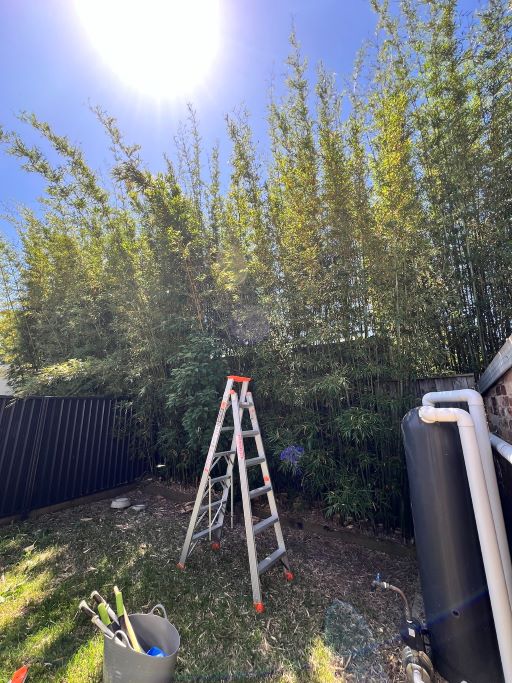
Bamboo neighbour disputes follow a familiar pattern. It starts small — a few culms poking through the fence, a strip of shade where there wasn’t one before. By the time someone picks up the phone or starts searching for answers, the bamboo has usually been a problem for months, sometimes years, and the relationship with the neighbour has often become strained.
The first thing worth knowing is that you are not in unusual territory. Bamboo disputes are common enough in NSW that the Land and Environment Court has decided multiple bamboo-specific cases, and the law has a clear, structured answer for almost every version of this problem. The second thing worth knowing is that the right next step depends entirely on what the bamboo is actually doing, and where you live.
This guide answers both. Work through the two questions below first — they determine which section of this guide applies to your situation.
Step 1 — What Is the Bamboo Actually Doing?
The legal pathway available to you depends on the specific problem. These are not mutually exclusive — bamboo often causes more than one of these issues — but identifying the primary problem tells you which legal test applies.
The bamboo is damaging my fence, pool, pipes or structure
This falls under the general damage provisions of the Trees Act. Bamboo rhizomes are notorious for cracking pool shells, lifting paving, breaking through dividing fences and infiltrating stormwater and sewer pipes. Because bamboo is legally a tree, your neighbour can be held responsible for damage their bamboo causes to your property — even though the rhizome causing the damage may now be on your side of the boundary.
Your pathway: Document the damage, raise it formally in writing, and if unresolved apply to the Land and Environment Court for orders requiring removal, root barrier installation, and/or compensation for repair costs. See Section 3 below.
The bamboo is blocking light to my window or a view from my home
This is specifically covered by the “high hedge” provisions of the Trees Act — Part 2A. A row or cluster of bamboo acting as a screen or hedge that has grown above 2.5 metres and severely obstructs sunlight to a window or a view from a dwelling can be the subject of a court application for pruning or removal orders.
Your pathway: This is the most well-established bamboo case type in NSW — the Land and Environment Court has decided several matters exactly like this. See the real case outcomes in Section 4 below before you proceed.
The bamboo is spreading under the fence but hasn’t caused damage or blocked anything yet
This is the earliest-stage version of a bamboo problem and the easiest to resolve without formal proceedings. Under common law, you are entitled to cut back any part of a neighbour’s bamboo — branches and roots — that crosses onto your land, at your own expense, without needing your neighbour’s permission or a court order. You must not damage the rest of the plant on their side, and you should offer the cut material back to them.
Your pathway: Self-help is usually sufficient at this stage. But the underlying spread will continue unless the source is managed — see Section 5 for what to say to your neighbour, and consider whether a root barrier on the boundary is the long-term fix.
Step 2 — Do You Live in a Free-Standing Home or a Strata Complex?
This matters because the legal pathway is different depending on whether the bamboo is on a neighbour’s private title, or on common property within a strata scheme.
Direct Neighbour Dispute
If you and the bamboo owner are both individual property owners (or one of you is a tenant of an individual owner), this is a straightforward application of the Trees (Disputes Between Neighbours) Act 2006. You deal with your neighbour directly, and if unresolved, you apply to the Land and Environment Court yourself. No strata manager, no committee, no by-laws involved.
Go to Section 3 (damage) or Section 4 (view/sunlight) below depending on your situation.
Runs Through the Strata Committee
If the bamboo is on common property, or on a neighbouring lot within the same strata scheme, the Trees Act still technically applies between the affected owners — but in practice the Owners Corporation usually needs to be involved, because bamboo on common property is the OC’s responsibility to manage under Section 106 of the Strata Schemes Management Act 2015.
Report it to your strata manager or committee in writing first. See Section 6 below for exactly how this works and what the OC’s obligations are.
Bamboo Causing Property Damage — Fences, Pools, Pipes
Running bamboo rhizomes spread laterally underground and are strong enough to crack masonry, lift paving and rupture irrigation and stormwater pipes. This is one of the most financially significant bamboo dispute categories because the damage cost is concrete and quantifiable.
What the Law Allows
Because bamboo is defined as a tree under the Trees (Disputes Between Neighbours) Regulation 2024 (NSW), the general tree damage provisions of the Act apply. If your neighbour’s bamboo has caused, or is likely to cause, damage to your property, you can apply to the Land and Environment Court for orders that may include:
- Removal of the bamboo, or the part of it causing the problem
- Installation of a root barrier between the properties at the bamboo owner’s expense
- Compensation for damage already caused — for example, pool shell repair, fence replacement, or pipe relining
- Ongoing maintenance orders requiring the bamboo to be kept below a specified extent
For dividing fence damage specifically, there is an overlap with the Dividing Fences Act 1991 (NSW) — if bamboo roots have damaged a shared fence, you may have a claim for contribution to repair costs under that Act as well as, or instead of, a Trees Act application. Which Act is the better fit depends on the specifics — get advice if the damage is significant.
What You Should Do First — Before Any Application
- Document everything. Photograph the damage, the bamboo’s extent on both sides of the boundary, and the rhizome if visible. Date every photo.
- Get a written assessment. A professional report — from a garden/bamboo specialist, a structural engineer, or a pool builder depending on what’s damaged — that confirms the bamboo as the cause is significant evidence. We provide written bamboo assessment reports specifically for this purpose.
- Quote the repair. A written quote for fixing the damage (pool resurfacing, fence replacement, pipe repair) establishes the compensation amount you may be seeking.
- Raise it formally in writing with your neighbour before any court application — see Section 7 below.
Under NSW law, you generally have six years from when the damage occurred to claim compensation for tree-caused property damage through the Land and Environment Court. If your bamboo damage happened some time ago and you didn’t pursue it, you may still be within time — but don’t delay further. Get advice on your specific timeline.
Bamboo Blocking Your View or Sunlight — The High Hedge Rules
This is the most legally developed category of bamboo dispute in NSW, because bamboo is so commonly planted specifically as a fast-growing privacy screen — which is exactly what generates conflict when it grows taller than intended.
The 2.5 Metre Rule
Under Part 2A of the Trees Act, a row of trees (which includes bamboo) is treated as a “hedge” if it forms a “hedge” in the ordinary sense — generally meaning two or more trees planted close together forming a visual screen. Once that hedge grows above 2.5 metres in height, it can become the subject of a court application if it is severely obstructing sunlight to a window of your dwelling, or a view from your dwelling.
“Severely obstructing” is a real legal threshold — minor inconvenience or a partially affected view is not enough. The Court assesses the obstruction objectively, often through an on-site inspection.
Real NSW Land and Environment Court Outcomes
Case Study — Robinson v Nagel [2021] NSWLEC 1356
Bamboo Hedge Removal Ordered, Balgowlah Heights
The Robinsons, living at Balgowlah Heights near Manly, applied to the Court after repeated unsuccessful attempts to get their neighbours, the Nagels, to prune a bamboo hedge planted in stages between 2013 and 2017. The Nagels argued the bamboo did not constitute a “hedge” because it had been planted at different times — the Court rejected this and found it formed a hedge for the purposes of the Act.
Acting Commissioner Galwey found the bamboo was severely obstructing the Robinsons’ view and ordered the Nagels to remove the bamboo hedge, take steps to prevent regrowth, and — to “future-proof” the outcome — ordered that any future hedge planted along that boundary be of a species that grows no taller than 2 metres at maturity.
Case Study — Royle v Debelak, Land and Environment Court
Ongoing Pruning Order, Newport — Sydney’s Northern Beaches
Mr Royle, a Newport resident, had been trying since 2016 to negotiate a bamboo hedge reduction with his neighbours — including offering in 2020 to carry out the pruning himself at his own cost. The bamboo was severely obstructing his views of Newport and Bilgola Beaches.
The Court was satisfied the obstruction was severe and ordered the respondents to prune the bamboo hedge down to the height of the applicant’s tennis court fence within 90 days, and — significantly — to maintain it at that height on an ongoing basis. This is the kind of ongoing maintenance order we have personally carried out as the contractor engaged to complete the court-ordered work — including the documentation required to demonstrate compliance.
Both cases share a pattern: the applicant tried direct negotiation first (sometimes for years), the bamboo had clearly grown into a “hedge” rather than an isolated clump, and the obstruction was assessed as severe rather than minor. If your situation matches this pattern — sustained obstruction, failed direct negotiation, bamboo over 2.5m — you have a recognised legal pathway.
What You Need to Apply
Before applying to the Land and Environment Court for a high hedge order, you generally need to show:
- You made reasonable efforts to resolve the matter directly with your neighbour first
- The bamboo forms a hedge (two or more plants forming a visual screen) above 2.5 metres
- It is severely obstructing sunlight to a window, or a view, from your dwelling
- You gave your neighbour at least 21 days’ written notice of your intention to apply, unless the Court directs otherwise
The Land and Environment Court’s Trees and Hedges page sets out the formal application process and the Court’s own practice notes for these matters.
Bamboo Just Spreading — What You Can Do Without Going to Court
If the bamboo hasn’t yet caused damage or blocked anything — it’s simply encroaching under the fence — you have more informal options before anything formal is needed.
Your Self-Help Rights
Under common law (separate from the Trees Act), you are entitled to:
- Cut any branches, culms or roots that cross the boundary onto your property, at your own cost
- Keep what you cut, but you should offer to return it to your neighbour first — disposing of it without offering can technically be treated as their property
- Do this without needing your neighbour’s permission, provided you don’t enter their land
What you cannot do:
- Enter your neighbour’s property without permission to cut bamboo on their side of the boundary
- Apply herbicide to roots that are still substantially on your neighbour’s property — this is legally ambiguous and risks a counter-complaint about damaging their plant
- Force your neighbour to remove the bamboo entirely without either their agreement or a Court order — cutting what crosses your boundary doesn’t compel them to deal with the source
The Better Long-Term Fix
Cutting bamboo that has already crossed onto your property treats the symptom, not the cause — running bamboo rhizomes will simply send up new growth again next season unless the rhizome network is interrupted. A root barrier installed along your side of the boundary (a buried HDPE barrier, typically to 600mm depth) physically blocks the spread without requiring your neighbour’s cooperation, provided it’s installed entirely on your own land. This is something we install regularly for exactly this situation — see our bamboo removal and root barrier cost guide for pricing.
Bamboo Disputes in Strata and Apartment Complexes
If you live in a strata scheme, the process looks different depending on where the bamboo actually is.
Bamboo on Common Property
If the bamboo causing the problem is growing on common property — a shared courtyard, a common garden bed along a boundary — the Owners Corporation is responsible for managing it under Section 106 of the Strata Schemes Management Act 2015, which requires the OC to maintain common property in good repair and prevent it from causing damage or nuisance.
If this bamboo is encroaching into a neighbouring property (outside the strata scheme) or causing internal disputes between lot owners, report it to your strata manager or committee in writing. The OC may need to engage a contractor to manage or remove it — and under the July 2025 amendments to Section 37 of the SSMA, committee members who receive a written complaint about a common property hazard and don’t formally respond are operating outside the due care and diligence standard now codified in law.
Bamboo on a Neighbouring Lot Within the Same Scheme
If a lot owner has planted bamboo within their own lot boundary (a private courtyard, for example) and it’s spreading into a neighbouring lot or common property, the Trees Act can still technically apply between the two lot owners as individuals — strata title doesn’t exempt a dispute between two private lots. However, the Owners Corporation’s by-laws (commonly Model By-Law 3 or equivalent) typically also prohibit owners from allowing their plants to encroach on or damage common property or other lots, giving the committee an additional, often faster, avenue to require remediation without a court application.
What to Do
- Report the issue to your strata manager in writing, with photos
- Ask whether it is being treated as a common property maintenance matter (OC responsibility) or a by-law breach by a specific lot owner
- If it’s a by-law breach, the OC can issue a notice to comply and apply to NCAT if it continues
- If informal resolution through the committee doesn’t work and the bamboo is causing the kind of damage or obstruction described in Sections 3 and 4 above, a Trees Act application remains available as a parallel option
The Full Resolution Process — Step by Step
Need a bamboo assessment or court-ordered remediation?
We provide written bamboo assessments for neighbour disputes and have completed Land and Environment Court ordered height reductions with full documentation.
Frequently Asked Questions
Is bamboo legally classified as a tree in NSW?
Yes. The Trees (Disputes Between Neighbours) Act 2006 (NSW) defines a “tree” broadly, and the Trees (Disputes Between Neighbours) Regulation 2024 (NSW) specifically prescribes bamboo as a tree for the purposes of the Act. This means all of the Act’s provisions for tree damage, dangerous trees, and high hedges apply to bamboo in exactly the same way they apply to any other tree species — including the ability to apply to the NSW Land and Environment Court for orders.
Can I cut my neighbour’s bamboo if it’s coming over the fence?
Yes — under common law, you can cut any part of a neighbour’s bamboo, including roots and culms, that crosses the boundary onto your property, at your own expense, without needing their permission. You cannot enter their property to do this, and you should offer the cut material back to your neighbour rather than disposing of it yourself, as it technically remains their property. This self-help right doesn’t require a court order and is the simplest first step if the bamboo hasn’t yet caused significant damage or obstruction.
How tall does a bamboo hedge need to be before I can take legal action over a blocked view?
Under Part 2A of the Trees (Disputes Between Neighbours) Act 2006 (NSW), a hedge must be above 2.5 metres in height to be the subject of a high hedge application. The bamboo must also form a genuine “hedge” — generally interpreted as two or more plants growing close together as a visual screen, even if planted at different times, as confirmed in Robinson v Nagel [2021] NSWLEC 1356. Beyond the height threshold, you must also show the hedge is severely obstructing sunlight to a window or a view from your dwelling — a real, significant obstruction rather than a minor inconvenience.
Has the NSW Land and Environment Court actually ordered bamboo to be removed or pruned?
Yes, on multiple occasions. In Robinson v Nagel [2021] NSWLEC 1356, the Court ordered a bamboo hedge in Balgowlah Heights removed entirely after finding it severely obstructed the applicant’s view, and ordered that any future replacement hedge be limited to 2 metres in height. In Royle v Debelak, the Court ordered a bamboo hedge in Newport pruned to a specified height within 90 days and maintained at that height ongoing, after finding it severely obstructed beach views. Both cases involved years of unsuccessful direct negotiation before the applicant went to Court, and both resulted in binding orders enforced against the bamboo owner.
Do I need a lawyer to apply to the Land and Environment Court over a bamboo dispute?
No. Applications under the Trees (Disputes Between Neighbours) Act 2006 are specifically designed to be accessible without legal representation, and the majority of applicants represent themselves. The process involves completing an application form available from the Court, providing supporting photographs and documentation, and demonstrating you made reasonable efforts to resolve the matter directly with your neighbour first. For high hedge (view/sunlight) applications, you must also give your neighbour at least 21 days’ written notice before applying, unless the Court directs otherwise. While legal advice can be helpful for complex matters, it is not a requirement to bring or respond to a bamboo dispute application.
What happens if bamboo on strata common property is causing a dispute?
If the bamboo is growing on strata common property, the Owners Corporation is responsible for managing it under Section 106 of the Strata Schemes Management Act 2015 (NSW), which requires common property to be maintained in good repair and not cause damage or nuisance. Report the issue in writing to your strata manager or committee. If the bamboo is on a neighbouring lot within the same scheme rather than common property, the Trees Act can still apply between the two lot owners directly, and the strata by-laws (commonly prohibiting plants from encroaching on common property or other lots) may provide an additional, often faster avenue through a notice to comply and, if necessary, an application to NCAT.
Related Bamboo Guides
- Bamboo removal cost Sydney 2026 — real prices, DIY tips and when to call a pro
- Bamboo trimming Sydney — how to shape, maintain and control bamboo
- Bamboo out of control in Sydney — the complete trimming guide
Need Help Resolving a Bamboo Dispute?
Garden Managers provides written bamboo assessments for neighbour disputes across Sydney, and we’ve completed Land and Environment Court ordered remediation with full documentation. Whether you need an independent assessment, a quote for removal or a root barrier, or court-ordered work completed and documented — we can help.