Bamboo Removal Cost Sydney 2026 — Real Prices, DIY Tips & When to Call a Professional
Bamboo removal is one of the most labour-intensive garden jobs in Sydney. It costs more than regular garden maintenance, takes longer than most people expect, and — if it involves a neighbour dispute — can end up in the NSW Land and Environment Court. This guide covers everything: real pricing, effective DIY methods, and the legal framework you need to understand.
✓ DIY That Actually Works
✓ Neighbour Dispute Guide
✓ NSW Legal Framework
Professional bamboo removal in Sydney costs $80–$100 per hour + GST for standard cutting and height reduction, and $100–$120 per hour + GST for full rhizome root excavation — significantly more than regular garden maintenance. A small residential bamboo clump costs $800–$1,800 to remove; a medium established clump $2,000–$4,500; large or extensively spread running bamboo $4,500–$12,000+. Add green waste disposal at $150–$280 per load — bamboo generates enormous waste volumes. DIY removal is possible for young or small clumping bamboo if done correctly. For mature running bamboo, bamboo near structures, or any situation involving a neighbour dispute, professional removal is necessary.
We receive bamboo calls from two very different groups of people. The first group has bamboo they want under control — trimmed, reduced, or removed entirely because it has grown beyond what they wanted when they planted it. The second group didn’t plant the bamboo at all. Their neighbour did. And now it’s spreading under the fence, breaking through their garden beds, and starting to lift the pavers on their patio.
Both situations require professional expertise, but they require it for different reasons. The first is primarily a horticultural challenge — bamboo root systems are far more extensive and resilient than most people expect, and effective removal requires the right technique applied persistently over time. The second adds a legal dimension — because in NSW, bamboo is legally classified as a tree under the Trees (Disputes Between Neighbours) Act 2006, which means your neighbour can take you to the Land and Environment Court over it. And they do.
This guide covers both situations — the practical and the legal — with real pricing, effective DIY techniques for situations where DIY makes sense, and a clear framework for knowing when you need professional help.
Why Bamboo Removal Costs More Than Regular Garden Maintenance
The most common reaction to a bamboo removal quote is surprise at the hourly rate. Garden maintenance starts at considerably lower rates — so why does bamboo command $80–$120 per hour?
There are five specific reasons:
1. The Root System Is Immense and Hidden
What you see above ground — the culms, the foliage, the towering stalks — is the visible fraction of the bamboo. The rhizome root network underground is the plant. Running bamboo (Phyllostachys species, the most common invasive type in Sydney) can spread its underground rhizome network horizontally at 1–2 metres per year, extending far beyond the visible canopy in every direction. Excavating this network by hand is intensive physical labour that takes much longer than it looks from the outside.
2. The Waste Volume Is Extraordinary
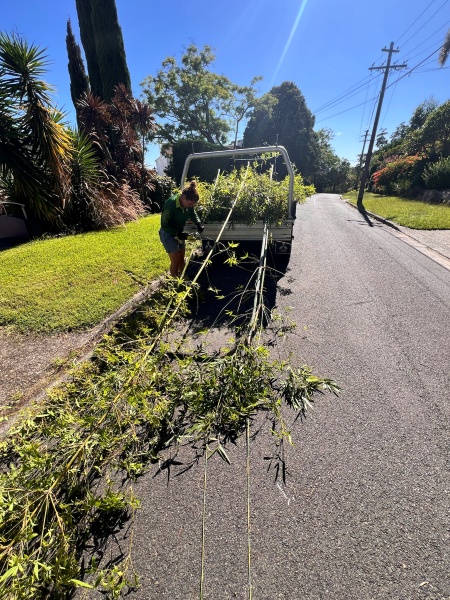
Bamboo generates more green waste per cubic metre of plant than almost any other garden material. A medium-sized bamboo grove being removed fills a standard trailer multiple times. The material is bulky, hollow, and doesn’t compact. Disposal at commercial green waste facilities adds real cost to every job — and those costs are passed on through waste disposal charges of $150–$280 per load.
3. Height Means Safety Equipment and Risk
Bamboo commonly reaches 6–10 metres in Sydney residential gardens. Working at that height with heavy cutting equipment, managing the fall direction of heavy culms in restricted urban spaces — adjacent fences, structures, neighbouring property — requires experience, appropriate equipment and genuine risk management. This is not a ladder-and-loppers job above 4 metres.
4. Multiple Visits Are Usually Required
A single bamboo removal visit rarely ends the job. Unless every rhizome is physically excavated — an extremely labour-intensive process — new culms will emerge from remaining root sections. Chemical treatment is effective but requires multiple applications over several months. The total job cost includes the follow-up visits, not just the first cut.
5. Specialist Knowledge Makes the Difference Between Success and Regrowth
Bamboo that is cut but not properly treated, or treated at the wrong time of year, or treated with the wrong chemical concentration, regrows reliably. We regularly take calls from homeowners who have spent $400 having someone cut their bamboo and found it fully regrown within 18 months. The correct technique — the right timing, the right treatment, the right follow-up — is what you are paying for at the professional rate.
Bamboo Removal Costs Sydney 2026 — Complete Price Guide
| Service | Rate / Cost 2026 | Notes |
|---|---|---|
| Standard bamboo trimming / height reduction Cutting culms, shaping, thinning |
$80–$100/hr + GST | Above-ground work. Multiple crew members typically required for height work. |
| Full rhizome root excavation Manual digging and removal of underground root network |
$100–$120/hr + GST | The most labour-intensive bamboo work. Physically demanding, slow and thorough. |
| Chemical treatment program Per treatment application + follow-up |
$80–$180 per treatment | Usually 3–5 treatments over 4–6 months. Most effective when combined with cutting. |
| Green waste disposal Per trailer/truck load |
$150–$280 per load | Bamboo generates very high waste volumes. Most jobs require 2–4+ loads. |
| Small clump removal Clumping bamboo or young running bamboo, under 3m spread |
$800–$1,800 | Cut, excavate, treat, remove waste. Typically 1–2 visits. |
| Medium established clump Running bamboo, 3–6m spread, established 3–7 years |
$2,000–$4,500 | Multiple visits, chemical program, significant excavation. |
| Large or extensively spread bamboo Running bamboo, 6m+ spread, established 7+ years |
$4,500–$12,000+ | Long-term program, significant root network, high waste volume. |
| Court-ordered height reduction Reduction to specified height, with documentation |
$80–$100/hr + GST + report | As per court order specifications. Written completion report for legal records. |
| Root barrier installation HDPE rhizome barrier to prevent spread |
$180–$320 per linear metre | Excavation to 600mm, barrier installation, backfill. Prevents future spread when installed correctly. |
“People sometimes compare our bamboo rate to what they’d pay for a standard lawn mow and ask why the difference. The honest answer is that bamboo removal is physically in a completely different category. On a typical morning, one crew member can mow, edge and weed a medium residential garden. The same crew member doing bamboo root excavation — mattock work, pulling rhizomes, barrowing the root material — might cover 3–4 square metres in that same morning. It is genuinely hard, specialised work. The rate reflects what the job actually requires.”
7 Metres to 3.5 Metres — What Happens When the Neighbour Goes to Court
We were recently engaged by a homeowner in Sydney’s Eastern Suburbs whose neighbour had successfully applied to the NSW Land and Environment Court under the Trees (Disputes Between Neighbours) Act 2006 — the legislation that, as of the regulations, specifically classifies bamboo as a tree for dispute purposes.
The bamboo had been growing at the rear of the property for approximately eight years. By the time of the court application, it had reached 7 metres in height and was significantly overhanging the neighbouring property, obstructing sunlight to a rear window and causing debris accumulation in the neighbour’s outdoor area. The neighbour applied to the Court without legal representation — as 84% of parties in NSW tree disputes do — and was successful.
The Court ordered the bamboo to be reduced from its then-height of approximately 7 metres to 3.5 metres and maintained at that height going forward. The order also required the work to be completed within 60 days by a qualified contractor and a completion report to be provided to the Court.
Our role: assess the bamboo, carry out the height reduction to the specified 3.5 metres, document the work with photographs, and provide the written completion report the court order required.
Key observations from this job:
- A bamboo stand that reaches 7 metres is not a simple ladder-and-loppers job. Working at that height in a constrained residential backyard, adjacent to a fence and neighbouring property, required careful planning of fall direction for each culm and appropriate equipment.
- The volume of waste material from a 3.5-metre height reduction across an established bamboo stand was substantial — multiple loads.
- The court documentation requirement — photographs before, during and after, written report confirming compliance with the order — is exactly the kind of evidence trail that protects the homeowner from further proceedings.
- The homeowner’s cost: approximately $1,400 for the height reduction, waste removal and completion report. The neighbour’s legal application cost: approximately $600 in court filing fees. The cost of ignoring the bamboo problem when it was smaller: immeasurably higher.
Bamboo and Your Neighbour — The NSW Legal Framework
We receive a significant number of bamboo calls that begin with some version of: “My neighbour is complaining about my bamboo.” Or: “My neighbour’s bamboo is coming through our fence and I don’t know what to do.”
Most people don’t know that in NSW, bamboo is legally treated the same as a tree for the purposes of neighbour disputes. The Trees (Disputes Between Neighbours) Act 2006 (NSW) defines a tree as including “any woody perennial plant, any plant resembling a tree in form and size, and any other plant prescribed by the regulations” — and the regulations specifically prescribe bamboo. This means your neighbour can take formal action through the NSW Land and Environment Court over bamboo on your property, without needing a lawyer.
What the Court Can Order
Under the Trees Act, the Land and Environment Court can make orders to:
- Remedy, restrain or prevent damage to a neighbouring property caused by bamboo — including root damage to structures, paving, drainage and retaining walls
- Reduce height if the bamboo severely obstructs sunlight to a window or a view from a neighbouring dwelling
- Require ongoing maintenance at a specified maximum height — as in the case study above
- Award compensation to a neighbour for damage already caused by bamboo roots or falling culms
- Require removal in cases of severe ongoing damage or risk
The Process — How Quickly This Can Move
NSW Land and Environment Court tree dispute statistics are instructive. In 2024, 75% of tree and bamboo disputes were finalised within six months of the application being filed. The median time from filing to decision was 108 days. Most parties represent themselves — this is not a process that requires expensive legal representation to initiate. Your neighbour can file an application, often for around $600 in court fees, and have a binding order in place within three to four months.
Do not ignore a formal written complaint about bamboo. In NSW, a neighbour who has complained in writing and received no response has stronger grounds for a court application. If you receive a formal complaint: acknowledge it in writing, engage a professional to assess the bamboo and provide a written report on what management is proposed, and begin that management promptly. A documented response showing you are actively managing the bamboo is significantly better than the alternative in any court proceedings. Contact us for a bamboo assessment and written report — this is specifically what you need in this situation.
When Bamboo Is Your Neighbour’s — What You Can Do
If running bamboo is spreading from a neighbouring property into your garden:
- Document first — photograph the bamboo on both sides of the fence, the extent of spread into your property, and any damage to your structures or garden
- Raise it in writing with your neighbour — a written letter or email requesting they manage the bamboo is the recommended first step. Keep a copy.
- Contact your council — some Sydney councils have vegetation management policies relevant to bamboo encroachment. Councils can sometimes assist with mediation before a court application.
- Apply to the Land and Environment Court — if the neighbour does not respond or the encroachment continues, an application under the Trees Act is your formal remedy. Most applicants in tree disputes are self-represented.
You are entitled under the common law to cut any part of a neighbour’s bamboo that extends over your property boundary — roots and above-ground growth. However, you must return the cut material to your neighbour (you cannot simply dispose of it), and you cannot enter their property without permission.
DIY Bamboo Removal — What Works, What Doesn’t, and How to Do It Properly
DIY bamboo removal can work — but only if you understand what makes bamboo resilient, use the right method, and apply it with genuine persistence over months. Most DIY attempts fail because they skip one of these elements.
When DIY Is Appropriate
DIY Works When…
- Clumping bamboo species (stays in place, doesn’t spread)
- Running bamboo planted within the last 2–3 years
- Small area, under 2 metres spread
- Height under 4 metres
- No bamboo near structures, pipes or fencing
- You have time for 3–4 months of follow-up treatment
Call a Professional When…
- Running bamboo established 5+ years
- Spread more than 3 metres from origin
- Bamboo over 4 metres tall (safety risk)
- Near fences, structures, drains or retaining walls
- Neighbour has complained or threatened court action
- You’ve tried DIY twice and it came back
The DIY Method That Actually Works — Step by Step
The single most effective DIY approach combines cutting with immediate chemical treatment. Cutting alone does not kill bamboo — it regrows reliably from the rhizome network. Chemical treatment alone on established bamboo is slow. Together, with correct timing and persistence, they work.
Tools you need:
- Reciprocating saw or sharp pruning saw for cutting culms
- Heavy-duty loppers for smaller stems
- Mattock or grubbing hoe for rhizome excavation
- Undiluted glyphosate herbicide (Roundup or equivalent) and a small brush or injection bottle
- Protective gloves, eye protection and long sleeves
Step 1 — Timing matters: The best time for chemical treatment of bamboo in Sydney is late summer to early autumn (February to April) when the plant is actively transferring energy from leaves to roots. Treatment at this time is significantly more effective than treatment in winter or early spring.
Step 2 — Cut all culms to 30–50cm above ground level using your saw. Do not cut to ground level — the short stump is your treatment point and gives you something to work with for chemical application.
Step 3 — Treat immediately. Within 30 seconds of cutting each culm, apply undiluted glyphosate to the freshly cut surface. The cut face is the entry point into the plant’s vascular system — it seals within minutes, and a sealed stem absorbs very little chemical. Speed is essential. Use a small paintbrush, a syringe or a squeeze bottle to apply to every single cut culm.
Step 4 — Excavate what you can reach. Using the mattock, dig around the base of the cut stumps and follow the rhizome network as far as you can reach without destroying your lawn or garden beds. Every rhizome section you physically remove is a section that cannot regrow. This is hard work but it accelerates the result significantly.
Step 5 — Monitor and retreat every 3–4 weeks. New shoots will emerge from remaining rhizome sections. Cut them immediately when they appear and treat the cut surface again. Do not allow new growth to reach more than 30–40cm before treating — young shoots have not yet hardened and are more susceptible to chemical treatment.
Step 6 — Repeat for 4–6 months. Complete elimination of an established bamboo rhizome network through this method takes a minimum of four months and often six. Most people give up too early. If you commit to monthly treatment rounds for six months, the result is permanent elimination of the bamboo.
Do not use a whipper snipper or lawn mower to cut bamboo stems at ground level without chemical treatment. Bamboo treated this way regrows vigorously — the root system is entirely undamaged and the plant simply sends up new culms. This is the most common reason DIY fails. If you cut without treating, you have done nothing except temporarily reduce the height. Similarly, do not apply glyphosate to bamboo foliage — uptake through leaves is very slow and mostly ineffective on established bamboo. Cut-and-treat through the stem is the correct method.
Which Type of Bamboo Do You Have? — It Changes Everything
Before spending money on removal, understand what you are dealing with. The two main categories of bamboo behave completely differently and require completely different management approaches.
Running Bamboo — The Invasive Type
Running bamboo (predominantly Phyllostachys species — golden bamboo, black bamboo, moso bamboo) spreads aggressively via horizontal underground rhizomes. The rhizomes can travel 1–2 metres per year in all directions, sending up new culms wherever they surface. This is the bamboo that crosses fences, lifts pavers, breaks into garden beds and generates neighbour disputes. It is also the bamboo that requires professional removal once it is established. If you can follow the visible root system underground and it extends in multiple horizontal directions away from the main clump — it is almost certainly running bamboo.
Clumping Bamboo — The Manageable Type
Clumping bamboo (Bambusa and Thamnocalamus species) grows outward slowly from a central root mass rather than spreading underground. The clump expands perhaps 10–20cm per year at its outer edge — manageable, predictable and containable. Clumping bamboo can be controlled by annual trimming of outer culms and periodic removal of the outer clump edge. DIY management is realistic for most clumping bamboo. It will not spread under your fence or lift your paving unless it is severely neglected for many years.
Dig carefully at the base of your bamboo clump and expose the root system. Clumping bamboo has a dense, woody, upward-growing root ball that stays close to the base of the clump — it looks like a tight mass of roots going down and slightly outward. Running bamboo has clearly horizontal rhizomes — smooth, segmented, spreading outward underground and typically quite close to the surface (10–30cm deep). If you find long horizontal roots extending well beyond the visible edge of the bamboo — it is running bamboo and it needs to be managed accordingly. Not sure? Send us a photo and we’ll identify it before you invest time or money in the wrong approach.
Bamboo on Strata Common Property — An Added Complication
Bamboo on strata common property creates the same practical problems as residential bamboo — with the addition of governance complexity. Under the Owners Corporation’s duty to maintain common property in good repair under Section 106 of the Strata Schemes Management Act 2015, the OC is responsible for managing bamboo on common property — including addressing any encroachment it causes into lot areas or neighbouring properties.
A strata committee that receives written complaints from a lot owner or neighbouring property about bamboo encroachment from common property, and does not act, is creating legal exposure under both the Trees Act (neighbour’s application) and the SSMA (lot owner’s Section 106 claim). Both are now actionable with longer limitation periods following the 2025 strata law reforms.
For strata garden maintenance programs we manage, bamboo assessment is part of every annual inspection — identifying any new rhizome spread beyond the intended area before it becomes a complaint or a court application.
Frequently Asked Questions — Bamboo Removal Sydney
How much does bamboo removal cost in Sydney in 2026?
Professional bamboo removal in Sydney in 2026 costs $80–$100 per hour + GST for above-ground cutting and height reduction, and $100–$120 per hour + GST for full rhizome root excavation. Total job costs depend on the size and age of the bamboo: a small clump (under 3m spread) costs $800–$1,800; a medium established clump (3–6m spread) costs $2,000–$4,500; large running bamboo with extensive spread costs $4,500–$12,000+. Green waste disposal adds $150–$280 per load, and bamboo generates very high waste volumes. Chemical treatment programs for ongoing management add $80–$180 per treatment application. Bamboo removal costs more than standard garden maintenance because the work is physically intensive, requires specialist technique, generates significant waste and typically requires multiple visits over several months for complete elimination.
Can my neighbour take me to court over my bamboo in NSW?
Yes. Under the Trees (Disputes Between Neighbours) Act 2006 (NSW), bamboo is legally classified as a tree — the regulations specifically prescribe bamboo as a tree for the purposes of the Act. This means your neighbour can apply to the NSW Land and Environment Court for orders requiring you to reduce the height, prune or remove bamboo if it is causing or likely to cause damage to their property, causing injury risk, or severely obstructing sunlight to a window or a view from their dwelling. Most applicants in NSW tree disputes are self-represented. In 2024, 75% of disputes were finalised within six months, with a median completion time of 108 days. The court can also order you to pay compensation for damage already caused by your bamboo roots or culms to your neighbour’s property.
Does cutting bamboo kill it?
No — cutting bamboo alone does not kill it. The above-ground culms are the visible portion of a plant whose root system (the rhizome network) survives any amount of cutting and simply sends up new growth. Bamboo that is cut without chemical treatment will regrow to its previous height within one to two growing seasons. Effective permanent removal requires either complete physical excavation of the rhizome network (which is extremely labour-intensive), or a sustained cut-and-treat program using glyphosate applied immediately to cut surfaces over 4–6 months, or a combination of both. The most common reason DIY bamboo removal fails is cutting without chemical treatment — or applying glyphosate to the foliage rather than to freshly cut stems.
What is the best time of year to remove bamboo in Sydney?
The most effective time for chemical treatment of bamboo in Sydney is late summer to early autumn — February to April — when the plant is actively translocating energy from its leaves down to its root system. Glyphosate applied to freshly cut stems during this period is carried most efficiently into the rhizome network, producing better kill rates than the same treatment applied in winter (when the plant is less active) or early spring (when the plant is directing energy upward into new culm growth). Physical excavation of rhizomes can be done at any time of year but is practically easier in the cooler months. For professional removal programs, we typically schedule the primary cut-and-treat in late summer and follow-up treatments through autumn and winter.
Can I remove bamboo that is crossing the fence from my neighbour’s property?
Under common law in NSW, you are entitled to cut any part of a neighbour’s bamboo — roots and above-ground growth — that extends over your property boundary. However, you must return the cut material to your neighbour — you cannot simply dispose of it. You cannot enter your neighbour’s property without their permission to carry out this work. If you apply glyphosate to bamboo rhizomes on your side that extend from your neighbour’s property, you are treating what is technically their plant — this is a legal grey area. The cleaner approach is to raise the matter in writing with your neighbour, and if they do not respond or manage it, to apply to the Land and Environment Court under the Trees Act for formal orders. This gives you a documented legal basis for the work and protection from any counter-claim.
How long does bamboo take to come back after removal?
Running bamboo that has been cut without chemical treatment typically begins sending up new culms within 4–8 weeks and returns to significant height within one to two growing seasons. Bamboo that has been treated with a correct cut-and-glyphosate program but with incomplete follow-up shows reduced regrowth — fewer culms, weaker growth — but may still persist if any rhizome sections survive the treatment. Complete elimination of an established running bamboo root system through the cut-and-treat method takes a minimum of 4–6 months of consistent follow-up treatment, and in some cases 12 months for very established plants. Physical rhizome excavation followed by chemical treatment of any regrowth produces the fastest and most permanent result. Clumping bamboo that is cut and treated does not spread and generally does not regrow from treated cut surfaces.
Related Bamboo and Garden Guides
- Bamboo trimming Sydney — how to shape, maintain and control bamboo
- Bamboo out of control in Sydney — the complete trimming guide
- Garden maintenance costs in Sydney 2026 — real prices and calculator
Get a Bamboo Assessment and Quote in Sydney
Garden Managers carries out bamboo assessments and removal across Greater Sydney. We’ll identify your bamboo type, assess the extent of the root system, and give you an honest written quote for the work required — including whether DIY is feasible for your situation. If you’ve received a neighbour complaint or court order, we can provide the documentation you need.