This guide covers everything Sydney homeowners, landlords, and strata managers need to know about bamboo trimming — which type you have, when to trim it, what it costs, what to do when it crosses the fence line, and when it’s time to stop wrestling with it yourself and call a professional.
We have managed bamboo across hundreds of Sydney properties — from compact Eastern Suburbs courtyards to large North Shore strata complexes — and we know exactly where it goes right and where it goes badly wrong.
Height bamboo can reach in Sydney in 3 years
Per year — ideal trim frequency for clumping
Minimum root barrier depth to contain running bamboo
Years managing bamboo across Sydney properties
First: Which Type of Bamboo Do You Have?
This is the single most important question in bamboo management — and most Sydney homeowners get it wrong. There are two fundamentally different types of bamboo, and the right management approach depends entirely on which one you are dealing with.
Clumping Bamboo
- Grows slowly outward from a central base
- New shoots emerge close to the parent plant
- Most common in Sydney gardens — gracilis is the typical variety
- Manageable with annual trimming
- Suitable near fences and paths with proper maintenance
- Does not usually cross boundary lines if maintained
- Generally not classified as noxious in Sydney councils
Running Bamboo
- Spreads via underground rhizomes — can travel metres per year
- Will cross fence lines, lift paths, and enter pipe systems
- New shoots can appear well away from the parent plant
- Classified as a noxious weed in some Sydney council areas
- Extremely difficult to eradicate once established
- Requires physical root barriers minimum 60cm deep
- Annual trimming alone will NOT contain it
Look at where new shoots are emerging. If they appear close to the base of the existing plant — within 30–50cm — you almost certainly have clumping bamboo. If new shoots are popping up a metre or more away from the main plant, under fences, or in unexpected locations, you have running bamboo and you need a more aggressive management plan.
When to Trim Bamboo in Sydney — Seasonal Timing Guide
Sydney’s climate means bamboo grows aggressively through spring and summer. Trim at the wrong time and you either stress the plant unnecessarily or undo the work within weeks. Here is the trimming calendar that actually works in Sydney conditions:
| Season | Months | What’s Happening | Trimming Recommendation |
|---|---|---|---|
| Summer | Dec – Feb | Active growth, new culms hardening | Avoid major trimming — light shaping only |
| Autumn | Mar – May | Growth slowing, culms mature | Good time to start — remove dead culms, thin |
| Winter | Jun – Aug | Dormant period, no new shoots | Best time to trim — full thinning, height reduction, reshaping |
| Spring | Sep – Nov | New shoots emerging rapidly | Avoid major cuts — control running shoots only |
Many Sydney homeowners trim bamboo in spring because that’s when it looks overgrown and suddenly visible. This is the worst time — you are cutting into active growth, stressing the plant, and the regrowth will be back to full height within 8–10 weeks. Winter trimming lasts far longer and produces a cleaner result.
The Mosman Property Where Bamboo Had Not Been Touched in Four Years
We received a call from a homeowner in Mosman who had moved into a property eighteen months earlier. The previous owners had planted a gracilis bamboo screen along the back fence — a good choice in theory. But in four years without a single professional trim, it had grown to over eight metres, was overhanging the neighbour’s garden by more than a metre, and had developed so many dead culms inside the clump that the screen was turning brown from the inside out.
What We Found
- Dead culm overload — approximately 40% of the canes inside the clump were dead or dying, blocking light and airflow to the healthy growth and accelerating the browning.
- Boundary overhang — the bamboo was extending more than a metre over the neighbour’s fence. The neighbour had already written to the owner twice requesting action.
- Clump spread — the base of the clump had expanded significantly toward a garden path, with new shoots beginning to lift the edge pavers.
- Root competition — the bamboo was competing aggressively with an established Camellia planted nearby, which had been struggling for three seasons.
What We Did — One Visit
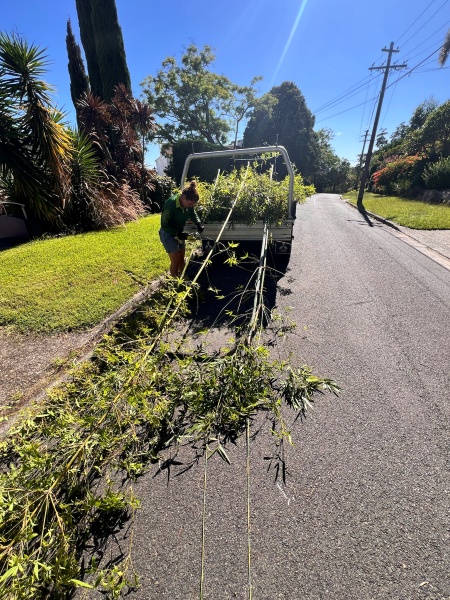
A full remediation visit with a two-person crew. Every dead culm removed at ground level. Height reduced from eight metres to four metres with clean cuts at nodes. Lateral growth pulled back to the property boundary. A root barrier trench cut along the path edge and filled with compacted gravel as an interim measure. All green waste removed from site — 1.5 cubic metres of bamboo cuttings.
Years without a professional trim
Height before intervention
Visit to fully remediate
Dead culms removed
The result: The bamboo screen looked better than it had in years — dense green growth from top to bottom once the dead material was removed and light could penetrate. The neighbour dispute was resolved. The path pavers were no longer under pressure. And the Camellia, freed from competition, flowered properly the following spring for the first time in three years. The owner now has Garden Managers on an annual winter maintenance schedule.
DIY Bamboo Trimming vs Calling a Professional — An Honest Comparison
Not every bamboo situation needs a professional. But knowing where the line is will save you time, money, and a very frustrating afternoon on a ladder with a handsaw.
- Bamboo is under 3 metres and easily reachable
- You just need a light tidy and shape
- Only a few dead culms to remove
- Clumping variety, well contained
- You have proper loppers or a pruning saw
- Green waste disposal is not an issue
- Bamboo is over 4 metres — ladder and saw work is hazardous
- It has not been trimmed in more than 2 years
- Dead culms make up more than 20% of the clump
- Running bamboo has escaped the original planting area
- Shoots are lifting paths, fencing, or threatening pipes
- Bamboo is overhanging a neighbour’s property
- It’s a strata common area with multiple screens to manage
- You need green waste removed — bamboo volume is significant
Bamboo cane density increases significantly once a clump is left untrimmed for more than two years. What looks like a manageable job from the outside often involves hours of work inside a dense, scratchy clump with limited visibility and awkward angles. We regularly receive calls from homeowners who have started a DIY bamboo trim, removed the accessible outer growth, and then realised the scale of what remains inside the clump. The remediation job is always more expensive than a scheduled annual service would have been.
How Much Does Bamboo Trimming Cost in Sydney in 2026?
Pricing varies based on the size of the bamboo, how long since the last trim, whether green waste removal is included, and how accessible the site is. Here is a realistic guide to what Sydney bamboo trimming costs:
- Light trim and shape
- Dead culm removal
- Green waste removal
- Site tidy on completion
- Full thinning and height reduction
- Clump interior cleared
- Boundary overhang removed
- Green waste removed
- Post-trim condition report
- Multi-crew attendance
- Root barrier assessment
- Running bamboo management
- Multiple screens or large areas
- Written report and maintenance plan
An annual winter maintenance visit for a standard bamboo screen typically costs $250–$350 and keeps bamboo permanently under control. Leaving it three or four years and then calling for a remediation job typically costs three to five times more. Annual scheduling is always the more economical choice.
Bamboo and Your Neighbours — Sydney Rules and Your Rights
Bamboo is one of the most common causes of neighbourly tension in Sydney gardens. Here is what you need to know about your rights and obligations:
What you can do on your side of the fence
Under NSW property law, you are entitled to trim any vegetation — including bamboo — that encroaches over your boundary line back to the boundary. You do not need your neighbour’s permission to do this. However, you must return the cuttings to your neighbour unless they agree otherwise in writing.
What you cannot do
You cannot enter your neighbour’s property to trim their bamboo without their permission, even if it is clearly overhanging your space. You also cannot apply herbicide to bamboo on your neighbour’s side of the fence — this could constitute property damage.
When bamboo roots cause damage
If running bamboo roots from your neighbour’s property are damaging your infrastructure — lifting paths, blocking pipes, damaging foundations — you may have grounds for a claim under the NSW Neighbourhood Disputes Act 2011. Document everything: photograph the roots, get quotes for repair work, and send a formal written request to your neighbour before escalating.
Running bamboo is classified as a noxious weed in some Sydney council areas, including parts of the North Shore and Inner West. If your neighbour has running bamboo and refuses to manage it, check with your local council — you may be able to lodge a formal complaint and the council can require them to take action. Clumping bamboo is generally not subject to noxious weed classification, but this varies by area. Always check with your specific council before making any formal complaint.
Bamboo in strata common areas
Bamboo planted in strata common areas is the owners corporation’s responsibility to maintain under Section 106 of the Strata Schemes Management Act 2015 (NSW). Overgrown bamboo that creates a safety hazard — overhanging walkways, reducing visibility, or blocking emergency access — can create liability for the owners corporation. See our full guide on strata garden maintenance in Sydney for more detail on compliance obligations.
How Garden Managers Approaches Bamboo Trimming
We have been trimming bamboo across Sydney properties for over ten years — from small courtyard screens in Randwick and Coogee to large strata common areas across the North Shore. Our approach is straightforward:
Assessment first
We identify your bamboo type, assess the current state of the clump including interior dead culm density, check for boundary issues and root spread, and give you an honest recommendation — including whether annual maintenance will be enough or whether a more active management approach is needed.
Proper tools and crew
Commercial-grade hedge trimmers, pole saws, loppers, and reciprocating saws — not a borrowed handsaw and a stepladder. For bamboo over five metres, we bring the right equipment and the right number of people to do it safely and efficiently in a single visit.
Complete green waste removal
Bamboo generates a significant volume of waste. We remove and dispose of all cuttings on the day — leaving bamboo on site risks it taking root. You are left with a clean, well-presented space, not a pile of canes to deal with yourself.
Written record for strata properties
For strata common areas, every bamboo service comes with a written report — what was done, what was found, and any recommendations for the next visit. This supports your compliance documentation requirements and gives your committee a clear maintenance record.
Related Guides and Services
If this article was useful, these related pages may also help:
- Our Bamboo Trimming Service — Sydney — full details on our bamboo trimming and maintenance service
- Best Hedge Plants for Sydney Homes — bamboo alternatives and complementary screening plants
- Privacy Hedges for Sydney Yards — fast-growing privacy screening options
- Trimming and Pruning Services Sydney — our full residential trimming service
- Strata Garden Maintenance Sydney — compliance-grade garden maintenance for strata schemes
For NSW legislation on neighbourhood vegetation disputes, refer to the Trees (Disputes Between Neighbours) Act 2006 on the NSW Legislation website and NSW Fair Trading guidance on common property.
Frequently Asked Questions About Bamboo Trimming in Sydney
Sydney’s Bamboo Getting Away From You?
Get a free quote from Garden Managers — we’ll assess your bamboo, tell you honestly what needs doing, and get it done properly in a single visit.