Who Pays for Garden Maintenance in a Strata Scheme? NSW 2026 Explained
It is one of the most common points of confusion in NSW strata living — and one that regularly generates disputes between committees, lot owners and tenants. The short answer is that it depends on where the garden is. The longer answer involves the strata plan, registered by-laws, recent legal changes, and a practical understanding of what “maintaining common property” actually requires from a committee in 2026.
✓ Common vs Lot Property
✓ By-Laws Explained
✓ Real Case Study
This guide explains the legal framework for strata garden maintenance responsibilities in NSW in plain English. It is not legal advice. Every strata scheme has its own strata plan and registered by-laws that determine exact responsibilities. When in doubt, consult your strata manager or a qualified NSW strata lawyer. References to legislation are accurate as at June 2026.
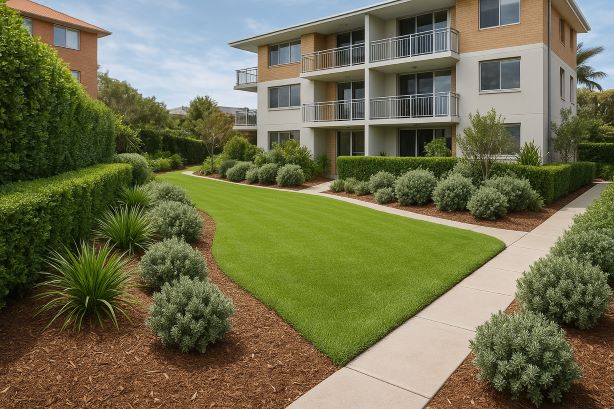
Common area gardens — shared entrances, garden beds along pathways, lawns in shared areas, irrigation systems serving common gardens: the Owners Corporation pays, funded from strata levies, under the strict duty to maintain common property in Section 106 of the Strata Schemes Management Act 2015 (NSW).
Garden areas within a lot’s boundaries — a courtyard or private garden that is part of the lot under the strata plan: the lot owner pays.
Exclusive use garden areas — common property that a by-law has granted to a specific lot for their exclusive use: depends on the by-law. Maintenance responsibility may stay with the OC or transfer to the lot owner depending on what the by-law says.
The most common source of confusion is the third category — exclusive use gardens where the by-law is ambiguous or where responsibility was never clearly documented when the exclusive use arrangement was created.
Garden maintenance disputes are more common in strata schemes than most committees expect — and most of them share the same root cause: nobody established clearly at the outset who is responsible for which garden areas, and that ambiguity has been allowed to persist for years.
The legal framework is actually reasonably clear once you know where to look. The Strata Schemes Management Act 2015 (NSW) places a strict obligation on the Owners Corporation to maintain common property — including gardens on common property — in a state of good and serviceable repair. The July 2025 amendments codified committee member duties to act with due care and diligence. And the extended six-year limitation period for Section 106 claims means that past maintenance failures are significantly more exposed than they were before 2025.
What this means practically: if the garden is on common property, the OC has a legal obligation to maintain it, and that obligation now has longer teeth than it used to. If the garden is lot property or exclusive use common property, the answer depends on what the strata plan says and what the by-laws specify.
Here is the complete picture.
The Legal Framework — Section 106 and What It Requires
Section 106 of the Strata Schemes Management Act 2015 (NSW) creates a non-negotiable duty: the Owners Corporation must maintain common property in a state of good and serviceable repair. This is not a discretionary obligation — it applies regardless of cost, regardless of levies, and regardless of whether the committee thinks the garden is “good enough.”
For gardens and grounds, this means:
- All garden beds, lawns, trees, hedges and plantings on common property must be maintained to a reasonable standard
- Irrigation systems serving common property gardens are common property infrastructure and fall within the Section 106 duty
- Pathways and steps in garden areas must be kept safe — trip hazards from tree root heave or deteriorating surfaces are a documented OC liability
- The duty is ongoing and active — it is not satisfied by doing nothing while the garden is visually acceptable
From 1 July 2025, the Strata Schemes Legislation Amendment Act 2025 strengthened these obligations in two additional ways relevant to garden maintenance:
- Section 37 — committee member duties: Committee members must now act with due care and diligence. A committee that receives reports of garden maintenance failures and does not formally respond is in breach of this duty.
- Limitation period extended to 6 years: The window for lot owners to bring a Section 106 claim has tripled from 2 to 6 years. Maintenance failures going back to approximately mid-2020 may still be actionable today.
The practical consequence for strata committees: garden maintenance is not optional, it cannot be deferred indefinitely, and the documentation of what was done and when now matters significantly more than it did before 2025.
Who Is Responsible — Garden by Garden
Common Area Gardens — Shared Entrances, Communal Lawns, Pathways
Funded by administrative fund levies
Irrigation Systems on Common Property
Routine service from admin fund / system replacement from capital works fund
Gardens Within a Lot’s Boundaries
Lot owner’s private expense
Balcony Gardens
With important exceptions
Exclusive Use Garden Areas
Check the registered by-law for your scheme
Trees
Boundary is what matters
Garden Fences and Retaining Walls
Structural common property
Paying for Garden Maintenance — But Getting No Value
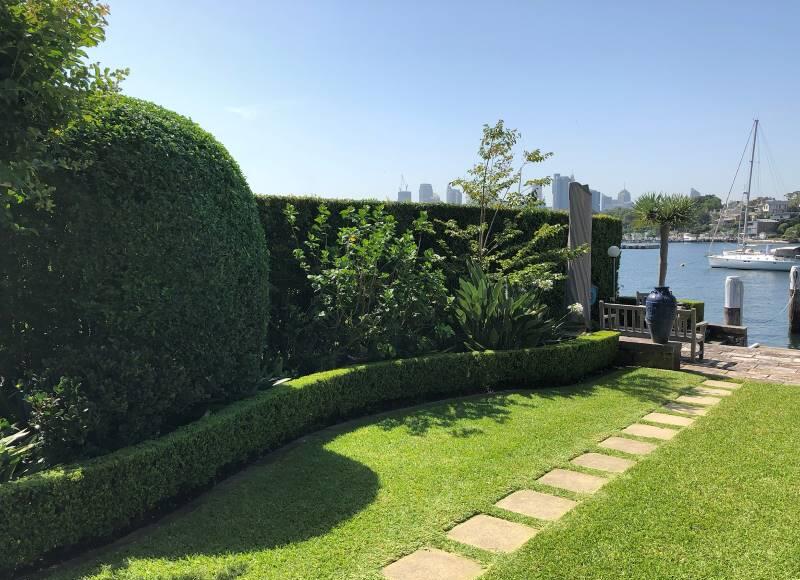
A strata committee in Double Bay contacted us earlier this year in a situation that illustrated, clearly, what happens when the OC’s garden maintenance obligation is being technically met — invoices being paid, a contractor attending the site — but the obligation is not actually being discharged.
The property had been well-maintained for years by a small, experienced local gardener who knew the site intimately. When that gardener retired, the committee moved quickly to find a replacement. The replacement was engaged without a site walkthrough, without a written scope of works, and without any handover from the previous contractor. There were no records of what had been maintained, what the irrigation schedule was, what irrigation faults had been identified, or what seasonal work had been done in previous years.
Over the following months, the new contractor attended regularly and invoices were paid. But without the site-specific knowledge the previous gardener had accumulated over years, and without any documentation to work from, the standard of maintenance declined progressively. Nobody noticed immediately — strata garden decline is a slow process. By the time a committee member raised the issue formally, the site was in a significantly neglected state.
When we were called in and assessed the property, we found:
- Multiple irrigation faults — the system had not been serviced since the previous contractor’s departure. A solenoid was partially stuck open, a zone had blocked drip emitters across an entire garden bed, and the controller schedule had not been adjusted from its summer settings. Left unaddressed, the combination of the stuck solenoid and the non-compliant schedule represented potential Sydney Water enforcement action and ongoing water waste that was already showing on the water bill.
- Significant site neglect — hedges that should have received a structural cut months earlier were well past the point where a single visit would restore them. Weed growth in garden beds had established to a depth that required more than routine maintenance to address. Mulch had depleted across the majority of the beds, leaving soil exposed and weed-prone.
- No visit records, no communication, no documentation — the committee had no record of what work had been completed, no photos of site condition over time, and no maintenance history that could be presented to an OC meeting, a new contractor, or an insurer if required.
Restoring the property to a maintainable standard required a full-day intensive visit — two crew members, a complete hedge structural cut, deep weeding across all beds, solenoid replacement, emitter flush, controller reprogram and mulch renewal. That work was necessary because routine maintenance had not been properly performed for an extended period. The cost was substantially higher than a standard maintenance visit.
The committee had been paying a contractor throughout this period. They had not been getting the maintenance those payments should have delivered.
The lesson is not that the previous gardener was irreplaceable — it is that the committee had no documentation, no scope of works, no visit reports and no way to measure what was being done against what should have been done. Without those tools, a committee cannot manage a garden maintenance contract effectively regardless of who is providing the service.
What Good Committee Management of Garden Maintenance Looks Like
The Double Bay situation is not unusual. It is, in our experience, representative of how garden maintenance is managed at a large number of Sydney strata properties — informally, without documentation, and without a clear scope against which performance can be measured.
The July 2025 amendments to Section 37 of the SSMA — requiring committee members to act with due care and diligence — make this informal approach a documented governance gap rather than just a practical problem. Here is what due care and diligence looks like in practice for garden maintenance:
1. A Written Scope of Works Before Any Contractor Starts
Every maintenance program should begin with a written scope that specifies: visit frequency, what is included in each visit (mowing, edging, weeding, hedge trimming, irrigation check), what is excluded, how additional works are quoted, and the reporting requirements. Without this document, there is no agreed standard against which the contractor’s performance can be assessed — and no basis for a formal complaint if the standard is not met.
2. Photo Reports After Every Visit
A written visit report with photographs — showing work completed and any issues identified — is the most important documentation in garden maintenance management. It creates a continuous, timestamped record of site condition and maintenance history. When a new contractor takes over, this record is the handover document that carries the accumulated site knowledge forward. When an insurance claim or Section 106 dispute arises, it is the evidence of active, diligent management.
The Double Bay committee had nothing like this when we arrived. They could not tell us when the hedges had last been cut, when the irrigation had last been serviced, or what issues the previous contractor had identified and addressed. That knowledge existed only in the previous gardener’s memory — and it left when he retired.
3. Contractor Due Diligence Before Engagement
Before engaging any garden maintenance contractor for common property work, the committee should confirm and document:
- Current public liability insurance certificate — minimum $20M, name of the insurer, policy expiry date. File it with the strata manager.
- Workers compensation coverage — covering all workers who will be on site
- ABN and business registration — confirming they are operating as a legitimate business, not a cash-in-hand sole trader with no business structure
- Site walkthrough before engagement — a contractor who quotes without walking the site is quoting without adequate knowledge of what the site requires. The walkthrough is also the opportunity to establish the scope and reporting requirements before work begins.
4. Handover Documentation When Changing Contractors
The Double Bay situation was made significantly worse by the absence of any handover between the outgoing and incoming contractors. A formal handover should include: current irrigation schedule and system documentation, records of any outstanding issues and their status, seasonal maintenance calendar, plant species notes for any specialist care requirements, and supplier contacts for materials (mulch, fertiliser, seasonal plants). If your contractor has been maintaining photo reports, those reports are the handover document.
5. Annual Irrigation Service and Compliance Confirmation
Under Sydney Water’s permanent Water Wise Guidelines, automated irrigation must run before 10am or after 4pm year-round. Fines for strata bodies corporate start at $550. An annual irrigation audit — confirming the system is operating correctly and on a compliant schedule — should be a line item in every strata maintenance program. The audit report is your compliance documentation under the due care and diligence standard now codified in Section 37 of the SSMA.
Taking on a new strata property or reviewing your maintenance program?
Garden Managers provides free site assessments with a written condition report — giving your committee the documentation baseline it needs before any program begins.
What Happens When Garden Maintenance Is Not Properly Managed
The legal and practical consequences of inadequate strata garden maintenance have become significantly more serious since 2025. Here are the four specific consequences committees face when the obligation is not properly discharged:
Section 106 Claims — Now a 6-Year Window
An owner who suffers loss as a result of the OC’s failure to maintain common property can bring a claim under Section 106 of the SSMA. From 1 July 2025, they have six years to do so from when they became aware of the loss. Garden maintenance failures — trip hazards from root heave, plant damage from irrigation failure, structural damage from neglected retaining walls — are all Section 106 matters. The extended limitation period means that failures that occurred years ago may still be actionable.
NSW Fair Trading Enforcement
The Strata Schemes Legislation Amendment Act 2025 gave NSW Fair Trading direct investigative and enforcement powers over Owners Corporations. A complaint from any resident — or Fair Trading’s own monitoring — can trigger an investigation into whether the OC is meeting its Section 106 maintenance duty. A committee that cannot produce maintenance records, contractor visit reports or documentation of how it has managed identified issues is in a very weak position in such an investigation.
Personal Committee Member Exposure
Under Section 37 of the SSMA as amended from July 2025, committee members must act with due care and diligence. The good faith protection in Section 260 of the Act — which ordinarily shields committee members from personal liability — is only available to members acting in good faith. A committee that received reports of garden maintenance failures, discussed them informally without formal resolution, and allowed the situation to persist for months or years is not easily characterised as acting in good faith.
Special Levies for Deferred Capital Works
Practical garden maintenance failures — an irrigation system that deteriorates for want of a $380 annual service, a retaining wall that fails for want of being included in the capital works plan — create the most tangible immediate cost. The committee that defers the $380 service eventually pays for a $6,000 emergency replacement. The committee that omits the retaining wall from the capital works plan eventually issues a special levy to cover an unplanned $15,000 replacement. Regular maintenance and proper capital planning cost less, not more, than the alternative.
Exclusive Use Gardens — The Most Common Source of Confusion
Many of the garden responsibility disputes we encounter involve exclusive use areas — common property that a registered by-law gives a specific lot owner the exclusive right to use. Ground-floor units with private garden spaces, townhouses with side garden access, apartments with their own courtyard entrance — these arrangements are common across Sydney strata, and the maintenance responsibility question is often not clearly settled.
The Critical Question — What Does the By-Law Actually Say?
The starting point for any exclusive use garden dispute is the registered by-law. Some exclusive use by-laws explicitly transfer maintenance responsibility to the lot owner — “the lot owner shall maintain the exclusive use area at their own expense.” Others are silent on maintenance — they grant exclusive use without addressing who maintains the space.
Where the by-law is silent, the default position under NSW strata law is that the OC retains maintenance responsibility for common property — including common property that has been granted for exclusive use. This means the OC may be responsible for maintaining a garden space that a specific lot owner uses as their private garden, unless a by-law explicitly transfers that responsibility.
The consequence: an OC that has been expecting a lot owner to maintain their exclusive use garden — because it feels like their private space — may actually be responsible for that maintenance under the registered by-law. If that garden is now in poor condition and the OC has not maintained it, Section 106 applies.
How to Fix the Ambiguity
If your scheme has exclusive use garden areas with unclear maintenance responsibility:
- Check the registered by-law for each exclusive use area — your strata manager can produce the by-law documents
- If the by-law is silent on maintenance, take legal advice on whether the OC or lot owner is responsible in your specific circumstances
- If the committee wants to transfer maintenance responsibility to the lot owner, this requires a formal common property rights by-law — a special resolution at a general meeting, with no more than 25% of votes cast against the motion
- Document the outcome in committee minutes regardless of which direction responsibility falls
Lot Owners, Tenants and the Maintenance Hierarchy
Can a Tenant Be Required to Maintain the Garden?
Yes — but only for lot property, and only through the tenancy agreement. A landlord can include garden maintenance of the private lot garden in the residential tenancy agreement, and this is common practice in Sydney. However:
- The tenancy obligation covers lot property only — a tenant cannot be made responsible for common property garden maintenance through a tenancy agreement
- Common property gardens remain the OC’s responsibility regardless of what a tenancy agreement says
- If a tenant fails to maintain their private lot garden in breach of the tenancy agreement, the recourse is through the landlord — the OC can request the landlord enforce the tenancy obligation, but cannot act directly against the tenant on a lot property matter
What If a Lot Owner Is Damaging Common Property Gardens?
Standard NSW strata by-laws (Model By-Law 3 and equivalent) prohibit owners and occupiers from damaging any lawn, garden, tree, shrub or plant on common property, or using any portion of common property as their personal garden without OC approval.
If a lot owner is removing plants from common property gardens, planting in common areas without approval, or allowing their own plantings to encroach on and damage common property — the OC can issue a notice to comply and, if the breach continues, seek orders through NCAT.
Garden Managers — Managing the OC’s Garden Maintenance Obligation Properly
For strata properties across Sydney, we provide the documentation-based maintenance program that discharges the OC’s Section 106 obligation and protects committee members under the due care and diligence standard now codified in Section 37.
Every Garden Managers strata program includes:
- Written scope of works before any program begins — clear inclusions, exclusions and reporting requirements
- Photo report after every visit — timestamped, issue-specific, formatted for committee records
- Formal written hazard reports — every identified risk documented and communicated to the strata manager
- Annual irrigation compliance confirmation — controller schedule documented, Sydney Water requirements verified
- Contractor insurance on file — public liability $20M+, workers compensation current, provided annually
- Site-specific knowledge retained — we document what we know so that knowledge exists in writing, not just in memory
- No lock-in contracts — 30-day cancellation
Frequently Asked Questions
Who is responsible for garden maintenance in a NSW strata scheme?
In a NSW strata scheme, the Owners Corporation is responsible for maintaining all gardens and grounds on common property under Section 106 of the Strata Schemes Management Act 2015. This includes common entrance gardens, shared lawn areas, garden beds along pathways, trees on common property and irrigation systems serving common areas. Lot owners are responsible for maintaining gardens that are within their lot’s boundaries on the registered strata plan. Exclusive use garden areas — common property granted to a specific lot for exclusive use — require checking the registered by-law to determine whether maintenance responsibility was transferred to the lot owner or remains with the OC.
Can a strata committee make a lot owner maintain their garden?
A strata committee can require a lot owner to maintain a private garden on their lot property if the scheme’s by-laws include a standard tidiness obligation — which most NSW strata schemes do under Model By-Law 3 or equivalent. The OC can issue a notice to comply and, if the breach continues, apply to NCAT for enforcement orders. However, if the garden area in question is common property — even if it feels like the lot owner’s private garden — the OC remains responsible for its maintenance unless a registered common property rights by-law specifically transfers that responsibility to the lot owner. A committee cannot enforce a maintenance obligation on a lot owner for common property they have been using exclusively without a registered by-law backing that up.
Who pays for irrigation maintenance in a strata scheme in NSW?
Irrigation systems installed on common property are common property infrastructure — their maintenance, repair and eventual replacement are the Owners Corporation’s responsibility under Section 106 of the Strata Schemes Management Act 2015. Routine irrigation service — annual audit, solenoid repairs, seasonal schedule adjustment — is an administrative fund expense. Full system replacement is a capital works fund item and should be included in the 10-year capital works fund plan. Sydney Water compliance for automated irrigation systems (running before 10am or after 4pm) is the OC’s obligation, with fines starting at $550 for bodies corporate. The committee is responsible for ensuring the irrigation system is serviced, compliant and documented.
What happens if a strata committee doesn’t maintain common property gardens?
Failure to maintain common property gardens creates three categories of risk for a NSW strata committee in 2026. First, Section 106 claims — lot owners can bring legal action against the OC for failure to maintain common property, and from 1 July 2025 they have six years to do so. Garden-related failures including trip hazards from path deterioration, plant damage from irrigation failure and structural damage from neglected retaining walls are all Section 106 matters. Second, NSW Fair Trading enforcement — the regulator now has direct powers to investigate OCs that fail their maintenance duty, without an individual owner having to initiate proceedings. Third, personal committee member exposure — under the July 2025 amendments to Section 37, committee members who fail to act with due care and diligence in managing the OC’s maintenance obligations face reduced protection under the good faith provisions of the Act.
Is an exclusive use courtyard garden maintained by the lot owner or the strata?
It depends entirely on the registered exclusive use by-law for that space. Some exclusive use by-laws explicitly transfer maintenance responsibility to the lot owner. Others are silent on maintenance — granting exclusive use without addressing who maintains the space. Where a by-law is silent, the OC typically retains maintenance responsibility for the exclusive use area as common property, regardless of the fact that only one lot owner uses it. If your scheme has exclusive use garden areas with unclear maintenance responsibility, the first step is to obtain the registered by-law from your strata manager. Legal advice is recommended where the by-law is ambiguous. If the committee wants to formally transfer maintenance responsibility to the lot owner for an exclusive use area, this requires a common property rights by-law — a special resolution at a general meeting.
Does a tenant have to maintain the garden in a strata property?
A tenant’s garden maintenance obligation is determined by the residential tenancy agreement — not strata by-laws. A landlord can include a requirement to maintain the private lot garden in the tenancy agreement, and this is common in Sydney. However, this obligation covers lot property only. Common property gardens remain the OC’s responsibility regardless of what a tenancy agreement says about garden maintenance. If a tenant fails to maintain a private lot garden in breach of their tenancy agreement, the OC’s recourse is to request the landlord enforce the tenancy obligation — the OC cannot act directly against the tenant for a lot property issue. Tenants are bound by the strata by-laws in relation to common property — they must not damage common area gardens or use common property as their personal garden without OC approval.
References
- Strata Schemes Management Act 2015 (NSW) — Section 106 (Common property maintenance duty), Section 37 (Committee member duties), Section 108 (Works by owners), Section 260 (Good faith protection)
- Strata Schemes Legislation Amendment Act 2025 (NSW) — Extended limitation period and committee duty amendments, effective 1 July 2025
- NSW Government — Strata Repairs and Maintenance
- NSW Government — Guide to Strata Law Changes for Committees and Owners
- Sydney Water — Water Wise Rules
- NSW Civil and Administrative Tribunal (NCAT) — strata dispute resolution
Is Your Strata Garden Maintenance Program Doing What the Law Now Requires?
Garden Managers provides written scope of works, photo reporting after every visit, irrigation compliance documentation and formal hazard reporting — across Greater Sydney. Free on-site assessment, fixed pricing, no lock-in contracts.