Overhanging Trees & Bamboo Neighbour Disputes in Sydney: What You Can Actually Do
Your neighbour planted a fast-growing privacy screen three years ago. Now it’s over your roof, through your fence, or pushing up your paving. NSW law gives you real options — but most people don’t know where they start, or when calling a professional beats calling a lawyer.
✓ What courts have ordered
✓ Step-by-step resolution
✓ When to act before spring
This post explains the general legal framework for tree and bamboo disputes in NSW based on publicly available legislation and court decisions. It is not legal advice. For specific situations — especially where property damage, injury risk, or court action is involved — seek advice from a qualified NSW solicitor.
Under the Trees (Disputes Between Neighbours) Act 2006 (NSW), bamboo is legally classified as a “tree.” If your neighbour’s tree or bamboo overhangs your property, you can trim it back to the boundary line from your side — at your own cost, without entering their land. If it’s causing damage, threatening injury, or the dispute escalates, you can apply to the NSW Land and Environment Court. Courts have ordered height reductions, full removal, fence replacement costs split 50/50, and compensation — all from a single bamboo dispute.
Sydney has a particular relationship with fast-growing privacy plants. Somewhere in the last decade, thousands of homeowners across the Eastern Suburbs, Inner West, and North Shore planted bamboo screens, Lilly Pillies, clumping grasses, and tall hedges along their boundary fences — often without fully understanding how fast they’d grow, how far they’d spread, or what their legal obligations would be once those plants started affecting the neighbours.
We’re now seeing the consequences of that wave of planting, and so are the courts. Bamboo that seemed like a perfect 3-metre screen three years ago is now 7 metres tall and arching into the neighbour’s yard. Lilly Pillies planted for a tidy hedge are dropping berries into a pool. A Phyllostachys clump has sent rhizomes under the fence and is now sprouting in someone else’s garden bed.
And every spring, it gets a little worse.
Here’s what you can actually do about it — whether you’re the person dealing with someone else’s encroaching plants, or the person who owns the plants and is about to receive a formal complaint.
First: does NSW law actually cover bamboo?
Yes — explicitly. The Trees (Disputes Between Neighbours) Act 2006 defines “tree” as any woody perennial plant, any plant resembling a tree in form and size, and any other plant prescribed by the regulations. Bamboo is specifically prescribed as a tree under those regulations — as is tiger grass, giant clumping grass, and large vines.
What that means practically: every right, obligation, and court power that applies to an overhanging gum tree or a boundary-crossing fig applies equally to your neighbour’s bamboo. The fact that it’s technically a grass doesn’t give it any special treatment. If it’s causing damage, threatening injury, or severely obstructing sunlight, the law treats it exactly the same as a mature eucalypt.
What you can do without any legal process
Before anything else — the good news. NSW law gives you a meaningful self-help right that most people don’t fully exercise before escalating.
- Trim any overhanging branches or bamboo back to the boundary line — from your side, without entering their property
- Remove bamboo shoots or rhizomes that have crossed onto your land
- Install a root barrier on your side of the fence to stop further rhizome spread
- Send a written letter to your neighbour describing the issue and requesting action
- Engage a contractor to do the trimming work on your side at your own cost
- Enter your neighbour’s property to prune or remove their plant without consent
- Damage the root system or kill the plant from your side
- Go straight to court without first attempting to resolve the dispute directly
- Demand your neighbour prune their own plant without following the proper process
- Claim costs for your own trimming work from the neighbour (unless court-ordered)
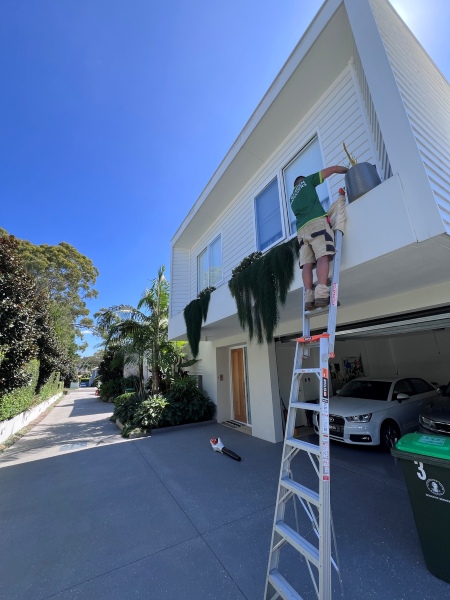
You can prune overhanging branches back to the boundary line, but you cannot damage the tree or take action that would compromise its structural integrity or health. Cutting back aggressively in a way that destabilises a large tree could expose you to liability if that tree later falls. For significant trees, get a professional to do the trimming — both for safety and to avoid any claim that you caused subsequent damage.
The step-by-step dispute resolution process in NSW
If the self-help approach hasn’t resolved it — or if the situation is beyond what trimming from your side can fix — here’s the process courts expect you to have followed before they’ll hear your application.
Have a conversation. Document it — note the date, what you said, and how they responded. This step is not optional: the Land and Environment Court requires evidence that you attempted to resolve the dispute before they’ll list your application for hearing.
If the conversation goes nowhere, put your concerns in writing — a letter or email describing the problem, what you’re asking them to do, and a reasonable timeframe to respond. Keep a copy. This becomes evidence if the matter escalates.
NSW Community Justice Centres offer free mediation for exactly this type of neighbourhood dispute. It’s not binding, but it often resolves things that direct communication doesn’t — and it shows the court you made a genuine effort if mediation fails.
Applications for tree and bamboo disputes go to Class 2 of the NSW Land and Environment Court. You can be self-represented — the court’s website has guides specifically for this, and there’s even a free student helpdesk for procedural assistance. About 75% of tree dispute matters are resolved within six months, with a median resolution time of around 108 days.
What courts have actually ordered — real outcomes
This is the part most people don’t know about, and it’s worth understanding before you either escalate a dispute or ignore one.
Running bamboo had grown along a boundary fence and displaced it structurally. The court found that where bamboo displaces a dividing fence, orders can be made for the entire fence length — not just the damaged sections. The court ordered all bamboo removed within 300mm of the boundary, the fence replaced with a timber paling fence, and costs shared 50/50 between both parties.
The bamboo owner didn’t just lose the plant. They paid half the cost of a new fence they’d had nothing to do with breaking.
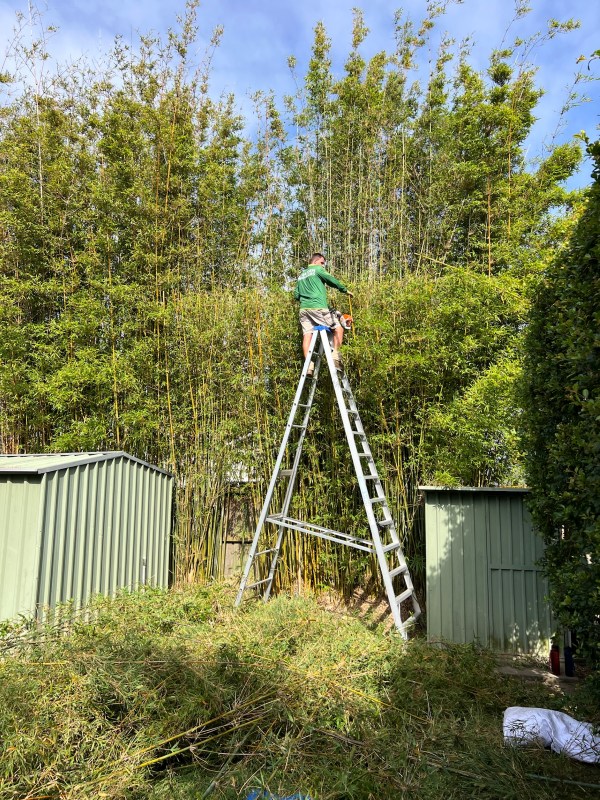
We’ve carried out court-ordered work following a Land and Environment Court ruling in a Sydney neighbour dispute. The bamboo had grown to approximately 7 metres and the court ordered a reduction to 3.5 metres. We completed the height reduction, removed the green waste, and provided a formal completion report for the court records. Total cost to the bamboo owner: approximately $1,400. The alternative — continuing to ignore the neighbour’s complaint — would have been the same outcome plus legal costs.
Failure to comply with a Land and Environment Court order can result in further proceedings and a fine of up to $110,000 under Section 15 of the Trees Act. Additionally, the local council can carry out the ordered work themselves and recover the costs plus an administrative fee from the non-compliant owner. Ignoring a court order is not a neutral position.
The spring timing problem — and why it matters right now
Every September and October we get a surge of calls from two directions at once: people whose neighbour’s bamboo or hedge suddenly exploded over winter and is now into their space, and people who planted a privacy screen one or two years ago and suddenly realise it’s become something they can’t manage on their own. Both groups have the same problem — the spring growth flush turned a manageable situation into an urgent one, almost overnight. The calls that come in after spring starts are always harder and more expensive to deal with than the ones that come in before it.
Sydney’s spring growth window — roughly September to November — is when bamboo, Lilly Pilly, photinia, and most fast-growing screening plants put on the bulk of their annual height and spread. A bamboo clump that seems contained in July can be meaningfully taller and wider by November. A Lilly Pilly hedge that was fine last spring may be pushing 30cm past your boundary by this spring if nobody has maintained it.
If you’re in a situation where overgrowth is becoming a dispute risk — either as the owner or the affected neighbour — acting now, before the spring flush, is significantly cheaper and easier than acting after it.
For a detailed breakdown of what bamboo control actually costs, see our bamboo removal cost guide. For the legal detail specifically on bamboo disputes, see our dedicated bamboo neighbour dispute guide. And if you’re trying to identify whether you’ve got running or clumping bamboo — which determines the entire risk profile of the plant — our running vs clumping guide walks through the five-minute field test.
🌱 Spring Hedge & Bamboo Tidy-Up Package — Book Before September
We’re taking bookings now for pre-spring hedge, bamboo, and screening plant work across Sydney’s Eastern Suburbs. Getting it done before the growth flush means less removal, lower cost, and no dispute risk heading into summer.
For strata committees — a note on your specific obligations
If the tree or bamboo in dispute is on strata common property, the legal position is different from a private residential dispute. Under the Strata Schemes Management Act 2015, the Owners Corporation is responsible for managing and maintaining all trees and plants on common property. If a plant on your common property is overhanging a neighbouring property or a lot owner’s private space, the OC — not an individual lot owner — is the responsible party.
The same escalation risk applies: an OC that ignores a written complaint about a common-property tree overhanging a neighbouring property can end up as a respondent in a Land and Environment Court application, with orders made against the OC and costs shared across all lot owners. Getting professional maintenance scheduled now — before a formal complaint is received — is almost always cheaper than responding to one.
Frequently Asked Questions
Can I cut my neighbour’s overhanging tree branches in NSW?
Yes — you have the right to prune overhanging branches back to your property boundary line, from your side, without entering your neighbour’s property. This applies to trees, hedges, and bamboo equally. You bear the cost of this work yourself unless a court orders otherwise.
You cannot enter your neighbour’s property to do this work without their consent, and you cannot take any action that damages or kills the tree. For significant trees, getting a professional to do the trimming protects you from any future claim that your pruning caused structural damage or destabilised the plant.
Is bamboo covered by the Trees (Disputes Between Neighbours) Act 2006?
Yes. Bamboo is specifically prescribed as a “tree” under the regulations made under the Trees (Disputes Between Neighbours) Act 2006. This means the same legal framework that governs disputes about overhanging eucalypts and fig trees applies to bamboo — including the court’s power to order height reduction, removal, and compensation for damage caused by rhizomes or overhanging culms.
What can the Land and Environment Court order in a tree or bamboo dispute?
The court has broad powers. It can order pruning or height reduction, partial or full removal, compensation for damage already caused, root barrier installation, fencing work (including requiring a fence to be replaced if it was damaged or displaced by the tree or bamboo), and ongoing maintenance obligations. Failure to comply with an order can result in fines of up to $110,000 and the council carrying out the work and recovering costs from the non-compliant owner.
In bamboo disputes specifically, courts have ordered bamboo to be removed within 300mm of a boundary fence and required the fence be replaced — with costs split between both parties — even where the fence damage was caused entirely by one neighbour’s plant.
Do I have to try mediation before going to court over a tree dispute?
You must demonstrate that you attempted to resolve the dispute before the court will list your application for final hearing. This doesn’t necessarily mean formal mediation — a documented conversation and written correspondence are usually sufficient to show you made a genuine attempt. However, free mediation through NSW Community Justice Centres is available and often resolves disputes that direct communication doesn’t, without any court costs or time commitment.
What’s the best way to deal with a neighbour’s bamboo before it becomes a dispute?
Act before the spring growth flush, which in Sydney runs from roughly September to November. Bamboo that seems contained in July can be substantially taller and wider by October. The most practical approach is to trim the overhanging portion from your side now — professionally, so the work is done cleanly and safely — and to write a friendly letter to your neighbour explaining what you’ve observed and asking them to consider managing the plant on their side as well.
If the bamboo is already crossing your boundary via underground rhizomes, a root barrier installed on your side can stop further spread without requiring your neighbour to do anything. If the encroachment is already significant, getting a professional assessment — including photos documenting the spread — gives you the evidence base you’d need if the situation ever escalates to a formal dispute.
References
- Trees (Disputes Between Neighbours) Act 2006 (NSW) — NSW Legislation
- Trees and Hedges — NSW Land and Environment Court
- Fences and Neighbour Disputes — Legal Aid NSW
- Trees and Neighbours — City of Sydney Council
Dealing with a bamboo or hedge overgrowth problem?
We handle bamboo containment, court-ordered reductions, hedge trimming, and boundary clearance work across Sydney’s Eastern Suburbs. Free site assessment, photo report provided.
This post is general information only and does not constitute legal advice. If your situation involves property damage, court proceedings, or a formal dispute, please seek advice from a qualified NSW solicitor.