Signs Your Strata Irrigation System Needs Replacing — Not Just Repairing
Another repair bill. Another solenoid. Another callout. At some point the honest question becomes: is this system worth keeping? Here are the 7 signs it isn’t — and what replacement actually involves for a Sydney strata property.
✓ Repair vs Replace Costs
✓ Real Case Study
✓ Vandalism Protection
Your strata irrigation system needs replacing — not repairing — when: the system is over 12–15 years old with multiple component failures, you’ve spent more than 60% of replacement cost on repairs in the last 3 years, the controller has no smart upgrade path, underground pipe deterioration is causing repeated leaks, or the original design no longer matches the current garden layout. For most medium Sydney strata properties, a full system replacement costs $4,500–$14,000 and is funded from the capital works (sinking) fund. The average repaired-to-death system wastes that amount in repair bills and water costs over 4–5 years before replacement becomes unavoidable anyway.
There’s a version of this conversation we have regularly with strata committees. The maintenance coordinator calls about another irrigation repair. We come out, fix the solenoid or the head or the leak, write up the report. Three months later, same call. Different zone, same story.
At some point — and the timing varies by system — continuing to repair becomes the more expensive option. Not the cheaper one. A system that costs $600 to repair four times a year is costing $2,400 annually in repairs alone, before you factor in the water waste from the intermittent faults between callouts. A replacement that costs $8,000 and lasts 15 years is $533 per year. The maths eventually becomes impossible to ignore.
The challenge is knowing when that threshold has been crossed — and making that case clearly enough to get a committee resolution. That’s what this guide is for.
The 7 Signs Your Strata Irrigation System Needs Replacing
No single sign automatically means replacement — context matters. But when multiple signs appear together, the case for replacement over repair becomes compelling.
Sign 1 — The System Is Over 12–15 Years Old With No Major Upgrades
Irrigation systems don’t have a universal lifespan — quality of installation, water quality and maintenance history all affect longevity. But as a practical guide for Sydney strata properties:
- Poly pipe and fittings: 15–20 years in good conditions, less in coastal Eastern Suburbs environments with UV exposure and salt air
- Solenoid valves: 8–12 years before wear begins to cause reliability issues
- Spray heads and rotors: 8–12 years before nozzle wear affects coverage uniformity
- Controllers: 10–15 years before electronic failure becomes common
A system installed in 2010–2012 is now at or approaching end-of-life across all major components simultaneously. Replacing individual parts on a 14-year-old system is like replacing individual tyres on a car with a cracked engine block — the underlying infrastructure is the problem, not the components on top of it.
“The systems that cause the most repeat callouts are almost always in the 12–18 year age range — old enough that the original components are failing, but recent enough that they were never designed for smart controller compatibility. Every repair we do on these systems is technically successful but the underlying pipes, valves and fittings are all approaching failure simultaneously. We tell the committee: you’re not paying for repairs. You’re paying rent on a system you’re going to replace anyway.”
Sign 2 — Repair Costs Have Exceeded 60% of Replacement Value in 3 Years
This is the clearest financial signal available. Add up every irrigation repair invoice from the last 36 months — solenoid replacements, head repairs, pipe fixes, callout fees, controller adjustments. If that total exceeds 60% of what a new system would cost, replacement is the financially rational decision.
The logic: if you’ve spent $4,800 repairing a system that costs $8,000 to replace, you’ve paid 60% of a new system’s cost — for a system that’s now 3 years older, still failing, and still going to need replacement eventually. You’ve effectively paid for most of a new system without getting one.
Ask your strata manager to pull all irrigation-related invoices from the last 3 years. Add them up. Then get a replacement quote. If repair costs ÷ replacement quote × 100 is above 60% — the committee has a clear financial case for replacement over continued repair. This calculation also constitutes documented due diligence in the capital works fund planning process.
Sign 3 — Multiple Solenoid Valves Are Failing in Sequence
One solenoid failure is a repair. Two solenoid failures in 12 months across different zones is a pattern. Three or more is a system-wide signal.
Solenoid valves on the same system typically have similar age and similar exposure history. When they start failing — and they do — they tend to fail progressively rather than all at once. The first failure is the warning. The second confirms the trend. By the third, you’re in a repair cycle that won’t stop until the valves are all replaced.
At that point the decision is: replace valves one by one as they fail ($150–$280 each, plus callout each time) or replace the valve manifold as part of a system upgrade ($400–$800 for a complete valve assembly, done once). On a four-zone system, individual replacements cost $600–$1,120 plus four separate callout fees. A manifold replacement as part of a controller upgrade costs less total and delivers a newer, more reliable system.
Sign 4 — Repeated Underground Pipe Leaks
An underground pipe leak that’s repaired cleanly and doesn’t recur is a repair. The same section of pipe leaking twice, or leaks appearing in different sections of the same zone, indicates pipe deterioration rather than an isolated fault.
Poly pipe deteriorates from UV exposure at exposed joints, from soil movement causing stress fractures, and from chemical degradation in certain soil conditions. Once deterioration begins in one section of a run, the adjacent sections are typically at similar risk. Excavating and repairing one section leaves the rest of the run at the same vulnerability.
For strata properties where repeated excavation means disruption to common area pathways, lawns or garden beds — the disruption cost of multiple isolated repairs often exceeds the cost of replacing the affected run comprehensively in a single mobilisation.
Sign 5 — The Controller Cannot Be Upgraded to Smart Management
Older irrigation controllers — particularly models from before 2015 — were not designed for smart expansion. They have no WiFi module slot, no Bluetooth capability and no compatibility with weather-based management platforms like Hydrawise.
For a strata committee that needs documented compliance with Sydney Water’s Water Wise Guidelines, an unupgradeable controller is a liability. It can’t automatically adjust for weather, it can’t be monitored remotely, and it can’t generate the compliance documentation that protects the Owners Corporation.
When controller replacement is necessary anyway, it’s the ideal trigger point to assess the whole system — because a new smart controller on a deteriorating pipe and valve system is still a deteriorating system. The controller is the most visible component but not the most critical one.
Sign 6 — Coverage No Longer Matches the Garden
Gardens change. Plants grow. Hedges expand. New garden beds are created. Hardscaping is added. Over 10–15 years, the garden that exists today may bear little resemblance to the garden the irrigation system was designed for in 2010.
A system designed for an open lawn area that’s now partially screened by mature hedges is watering the hedges more than the lawn. A drip system designed for a sparse new planting that’s now a dense established garden bed is under-delivering water to plants that need more. An irrigation system that was correctly designed for a 2010 garden may be completely wrong for the 2026 version of the same property.
Redesigning an irrigation system to match the current garden — new zone configuration, appropriate head placement, correct emitter types — is only possible on a full replacement. You can’t redesign a system through repairs.
Sign 7 — Water Bills Remain High Despite Repeated Repairs
If a strata property’s water bill stays elevated despite repairing identified faults, one of two things is true: there are additional faults not yet found, or the system is inherently inefficient due to age and design. Either way, the underlying cost driver hasn’t been addressed.
A new system — properly designed, with appropriate pressure compensation, efficient emitter types and a smart controller that adjusts for weather — typically reduces irrigation water consumption by 30–50% compared to a 15-year-old system running on a basic timer. On a medium strata complex spending $3,000–$6,000 per year on water, that saving is $900–$3,000 annually. Over 15 years, the water savings alone can offset a significant portion of replacement cost.
Vandalism Damage, 24-Hour Replacement, and Why We Built It to Last
A strata committee in Sydney’s Eastern Suburbs called us after discovering their irrigation system had been damaged — the controller and exposed valve assembly were outside the complex boundary and had been deliberately interfered with. The damage was significant: the controller was destroyed, two solenoid valves were broken, and the main supply fitting was fractured.
The committee needed the system operational as quickly as possible. We assessed the damage the same day and had a full replacement completed within 24 hours. But rather than simply restoring what was there before, we built the replacement with vandalism protection as a core design principle:
- Irrigation controller relocated underground into a lockable, heavy-duty irrigation valve box — no longer visible or accessible from outside the property boundary. Out of sight, out of reach.
- Vandalism-proof tap fitting installed on the supply line — requiring a specialist key to operate, eliminating the ability to turn off or tamper with the water supply from outside the property
- All valve connections secured within the underground box, removing the exposed above-ground assembly that was the point of vulnerability
- Hunter Node BT Bluetooth controller specified — programmed remotely via smartphone, meaning there’s no physical interface panel to damage or tamper with
The result: the new system is operationally equivalent to the old one but physically protected against the same type of interference. The committee has not had a single issue since installation. The strata manager received a full written report with photos for their records and insurance documentation.
This job illustrates something important about irrigation replacement: the opportunity to fix not just what failed but the vulnerabilities that made failure possible in the first place. A like-for-like replacement would have recreated the same exposure. A considered replacement eliminated it.
Emergency irrigation damage or system failure?
We provide rapid-response irrigation assessment and replacement across Greater Sydney — same-day assessment, 24-hour replacement where required.
Repair vs Replace — The Honest Cost Comparison
This is the calculation that matters most for a strata committee. Here’s a realistic comparison for a typical medium Sydney strata property with a four-zone system:
| Scenario | Year 1 | Year 3 | Year 5 | Year 10 |
|---|---|---|---|---|
| Keep repairing old system Avg $1,800/yr repairs + water waste |
$1,800 | $5,400 | $9,000 | $18,000+ |
| Replace now — new smart system $8,500 install + $200/yr service |
$8,700 | $9,100 | $9,500 | $10,500 |
| Water savings (30% reduction) Approx $1,200/yr on old system |
-$1,200 | -$3,600 | -$6,000 | -$12,000 |
| Net cost — replacement (after water savings) | $7,500 | $5,500 | $3,500 | -$1,500 |
By year 5, the new system has paid for itself through water savings and eliminated repair costs. By year 10, it’s actually cheaper in total cost than continuing to repair the old system would have been — and the committee has a functioning, compliant, documented system rather than an increasingly unreliable one.
Water waste from a poorly functioning old system is invisible in the repair budget — it shows up in the water bill, which is often treated as a fixed cost rather than a controllable one. A system running 20% more water than needed due to misaligned heads, stuck solenoids and unscheduled run time on a medium strata complex can waste $1,000–$2,500 per year. This cost appears nowhere on the irrigation repair invoices but it’s directly caused by the system condition. Include it in your replacement cost-benefit analysis for the committee.
What a Full Strata Irrigation System Replacement Involves
Many committees hesitate on replacement because the scope feels unknown. Here’s what it actually involves for a typical strata property:
-
1
System Design and Zone Planning
The first step is mapping the current garden against the ideal irrigation coverage — identifying zones, appropriate head types for each area (rotors for lawn, drip for garden beds, pop-ups for smaller areas), pressure requirements and the optimal controller configuration. For strata properties, this design phase also considers vandalism exposure, controller location, access for maintenance and Sydney Water compliance requirements.
-
2
Pipe Run Installation or Replacement
Depending on the existing pipe condition, either new runs are installed or the existing runs are replaced. Modern poly pipe with appropriate UV-stabilised fittings has a 20–25 year expected lifespan when correctly installed. All underground connections are made with compression fittings rather than push-fit where possible — significantly more durable in Sydney’s variable soil conditions.
-
3
Valve Manifold and Solenoid Installation
New solenoid valves installed in a valve manifold — either above-ground in a protected housing or, for vandalism-exposed locations, underground in a lockable irrigation valve box as we did in the case study above. Rain Bird and Hunter valves are our standard specification for strata properties — both have Australian market presence and parts readily available across Sydney.
-
4
Smart Controller Installation and Programming
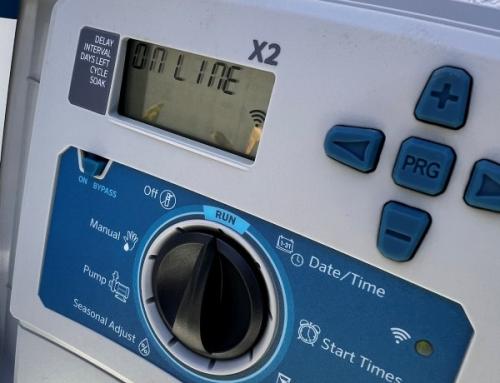
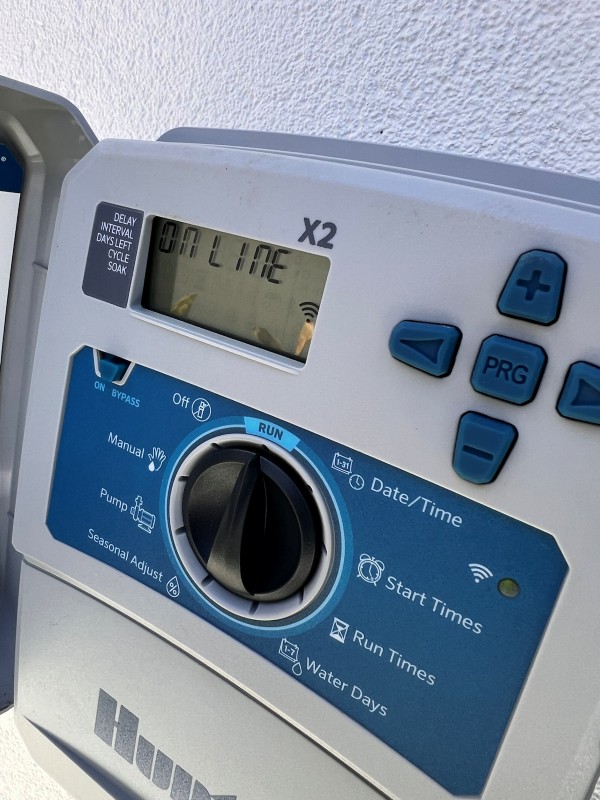
Hunter Hydrawise Pro-HC for properties with WiFi access at the controller location — remote monitoring, weather integration and contractor dashboard visibility. Hunter Node BT Bluetooth for valve box installations where mains power isn’t available. Both are programmed with Sydney Water-compliant schedules and documented in the handover report.
-
5
Head Installation and Coverage Testing
All sprinkler heads and drip emitters installed, each zone activated and walked during installation to confirm coverage pattern before backfilling and final landscaping reinstatement. Any coverage adjustments made during this commissioning walk rather than after the ground is closed. Photos taken of each zone running for the committee report.
-
6
Committee Handover Documentation
Written handover report including: zone map, controller programming details, Sydney Water compliance confirmation, component specifications and expected service intervals. For strata committees, this documentation goes into the maintenance records and supports the capital works fund plan. Insurance documentation provided separately if required — as in the vandalism case study above.
Vandalism Protection — Why It Matters for Exposed Strata Systems
Strata properties have a specific vulnerability that residential gardens don’t — publicly accessible common areas. An irrigation controller mounted on a boundary fence or a valve assembly at footpath level is exposed not just to weather and accidental damage but to deliberate interference.
We encounter this more than most committees expect. Controllers switched off, taps turned on or off, valve caps removed, fittings deliberately broken. For a strata complex that relies on its irrigation system for common property presentation and Sydney Water compliance, deliberate interference creates both operational and legal problems.
The Underground Valve Box Solution
The most effective vandalism protection for strata irrigation is removing the point of vulnerability entirely — placing the controller and valve assembly underground in a lockable, heavy-duty irrigation valve box.
What this achieves:
- Controller invisible from outside the property — if it can’t be seen, it’s significantly less likely to be targeted
- Physical access requires a key — the valve box lid is lockable, requiring deliberate and audible access rather than opportunistic interference
- Weather protection — underground installation also protects against UV degradation, temperature extremes and water ingress that shortens the life of above-ground installations in Sydney’s coastal conditions
- Bluetooth management eliminates the need to open the box — with a Hunter Node BT controller, our team programs and monitors the system from a phone without opening the valve box, meaning routine maintenance doesn’t require physical access to the vulnerable assembly
The Vandalism-Proof Tap
For the water supply connection, a specialist key-operated tap fitting eliminates the ability to turn off the water supply without authorisation. Standard tap fittings on exposed supply lines can be turned off by anyone — frustrating for the committee, potentially damaging to plants during hot weather if the system is switched off and nobody notices for days.
Key-operated tap fittings require a specific tool to operate. They’re available through irrigation suppliers across Sydney and add minimal cost to an installation — but provide meaningful protection against the most common form of water supply interference on exposed strata sites.
Getting Committee Approval — Capital Works Fund and the Resolution Process
An irrigation system replacement is a capital works item — it’s a renewal of a long-life common property asset rather than routine maintenance. Under the Strata Schemes Management Act 2015 (NSW), capital works expenditure should be funded from the capital works (sinking) fund and will typically require a committee resolution.
What the Committee Needs to Pass a Resolution
- Written quotes — minimum two quotes for comparison, with itemised scope so the committee can evaluate like for like
- Existing repair cost history — 3 years of irrigation repair invoices demonstrating the repair trajectory
- Capital works fund balance confirmation — from your strata manager, confirming the fund has capacity for the expenditure
- Written recommendation — from your garden maintenance provider, explaining why replacement is the recommended course of action and what the new system will include
- Compliance documentation — confirming the new system will meet Sydney Water requirements and the smart controller specification
Garden Managers can provide all of the above in a single proposal document formatted specifically for committee presentation and resolution. We’ve done this for multiple strata committees across Sydney’s Eastern Suburbs and understand what strata managers need to move a capital works item through the approval process efficiently.
Irrigation Replacement as Part of Your Strata Maintenance Program
For strata properties across Greater Sydney, we provide the complete irrigation replacement service — from initial assessment and committee proposal through to installation, commissioning and ongoing service.
Every strata irrigation replacement we complete includes:
- Free site assessment and written fixed-price proposal formatted for committee minutes
- Two-quote assistance — we can recommend other providers for comparison if required
- Full installation including zone design, pipe, valves, heads and smart controller
- Vandalism protection assessment — underground valve box and key-operated tap where exposure exists
- Hunter Hydrawise or Node BT specification — Sydney Water compliant, contractor dashboard enabled
- Complete committee handover documentation — zone map, compliance confirmation, service schedule
- Ongoing irrigation service as part of your strata maintenance program
What Does Strata Irrigation System Replacement Cost in Sydney 2026?
| Property Type | Typical Replacement Cost 2026 | Notes |
|---|---|---|
| Small strata block 6–12 lots, 2–3 zones |
$1,800–$3,500 | Full system including controller, valves, pipe and heads |
| Medium complex 20–40 lots, 4–6 zones |
$3,500–$8,000 | Includes smart controller, vandalism protection assessment |
| Large estate 50+ lots, 8+ zones |
$8,000–$20,000+ | Multi-controller setup, flow monitoring, full zone redesign |
| Controller replacement only Existing pipes and valves retained |
$420–$1,100 | Hunter Hydrawise or Node BT, supply and install |
| Valve manifold replacement All solenoids replaced in one job |
$500–$1,300 | More cost-effective than individual replacements over time |
| Underground valve box installation Vandalism protection, lockable |
$380–$580 | Includes excavation, box, relocation of controller and valves |
| Vandalism-proof key tap fitting Supply line security |
$160–$280 | Specialist key required to operate — eliminates supply interference |
All prices are indicative for Greater Sydney in 2026. Exact costs depend on site conditions, existing infrastructure reuse and access. Garden Managers provides free site assessments and fixed-price proposals for all strata irrigation replacement projects.
Frequently Asked Questions
How much does it cost to replace a strata irrigation system in Sydney?
A full strata irrigation system replacement in Sydney costs $2,800–$5,500 for small blocks (6–12 lots, 2–3 zones), $5,500–$10,000 for medium complexes (20–40 lots, 4–6 zones), and $10,000–$22,000+ for large estates with 8 or more zones. If only the controller needs replacing and the existing pipes and valves are in good condition, a smart controller replacement costs $420–$950 installed. Strata irrigation replacement is funded from the capital works (sinking) fund and requires a committee resolution under the Strata Schemes Management Act 2015 (NSW).
How often do irrigation systems need to be replaced?
A well-maintained irrigation system typically has a lifespan of 15–20 years for the pipe infrastructure and 10–15 years for valves and controllers. In Sydney’s Eastern Suburbs coastal conditions — UV exposure, salt air, variable soil movement — the practical lifespan is often toward the lower end of these ranges. Most strata properties should plan for irrigation system replacement in their 10-year capital works fund plan at the 15-year mark as a standard asset renewal, not as an emergency expenditure.
Can you replace just the irrigation controller without replacing the whole system?
Yes — if the existing pipes and solenoid valves are in good condition, replacing only the controller is a cost-effective upgrade. A Hunter Hydrawise Pro-HC WiFi smart controller or Hunter Node BT Bluetooth controller connects to existing wiring and valves regardless of brand — Rain Bird valves work perfectly with Hunter controllers and vice versa. Controller-only replacement costs $420–$950 installed in Sydney in 2026. We recommend a system audit before committing to a controller-only replacement to confirm the valves and pipes are worth preserving.
What is the best way to protect strata irrigation from vandalism?
The most effective vandalism protection for strata irrigation combines three elements. First, relocate the controller underground into a lockable, heavy-duty irrigation valve box — removing the visual target and requiring deliberate access with a key. Second, install a vandalism-proof key-operated tap fitting on the supply line — preventing unauthorised water supply interference without a specialist key. Third, specify a Bluetooth controller like the Hunter Node BT — which is programmed remotely via smartphone with no physical interface panel to damage. This combination removes all three common vandalism points and is what we install as standard on strata sites with known or suspected exposure risk.
Does strata irrigation replacement need committee approval?
Yes. Irrigation system replacement is a capital works item under the Strata Schemes Management Act 2015 (NSW) — it’s a renewal of a long-life common property asset, not routine maintenance. It should be funded from the capital works (sinking) fund and requires a committee resolution before work is instructed. Emergency replacement (such as system failure immediately before a seasonal peak or following vandalism damage) may proceed more quickly under urgency provisions, but the committee should be notified and a resolution ratified at the next meeting. Garden Managers provides proposal documentation specifically formatted for strata committee presentation and resolution.
Is winter the best time to replace a strata irrigation system?
Yes — winter (June–August) is the best time to replace a strata irrigation system in Sydney for three practical reasons. First, irrigation demand is at its lowest, so a temporary service interruption during installation causes the least plant stress. Second, irrigation contractors and suppliers have better availability in winter than in spring and summer when demand peaks. Third, replacing in winter means the new system is fully commissioned, tested and running on its spring schedule before September when irrigation demand increases significantly. A system replaced in July is settled and proven by the time it matters most.
Is Your Strata Irrigation System Ready for Replacement?
Garden Managers provides free on-site irrigation assessments and fixed-price replacement proposals for strata properties across Greater Sydney. We’ll tell you honestly whether your system needs repair, partial upgrade or full replacement — and document the recommendation for your committee.