In Sydney’s high-value property market, maintaining common property is not just about aesthetics—it is a critical legal and financial imperative. For Strata Committees and Strata Managers, the line between a well-managed garden and a lawsuit is often a single lifted paver.
Uneven paving, invasive tree roots, and neglected footpaths can rapidly escalate from minor defects into costly public liability claims. To protect your scheme, you need a structured approach to landscape risk management.
🛑 Key Takeaways for Strata Committees
- Legal Duty: The Strata Schemes Management Act 2015 (NSW) mandates the Owners Corporation must maintain common property to avoid negligence claims.
- The Big Risks: Uneven pavers, tree root upheaval, and cracked concrete are the top causes of public liability claims in Sydney.
- The Solution: Regular safety audits, slip-compliant materials (AS4586), and proactive arborist reports are cheaper than litigation.
Understanding the Sydney Strata Safety Landscape
Every year, thousands of slip and trip incidents lead to injury and insurance notifications across NSW. Under the Strata Schemes Management Act 2015 (NSW), the Owners Corporation has a strict duty to maintain common property in good working order.
The Reality of Liability
Failure to act on an identifiable hazard doesn’t just risk legal action; it can undermine your insurance coverage. If a committee is aware of a trip hazard (e.g., noted in meeting minutes) and fails to remediate it, the insurer may deem this “negligence,” potentially leaving lot owners personally exposed to costs.
Trip Hazard Removal: Preventing the Fall
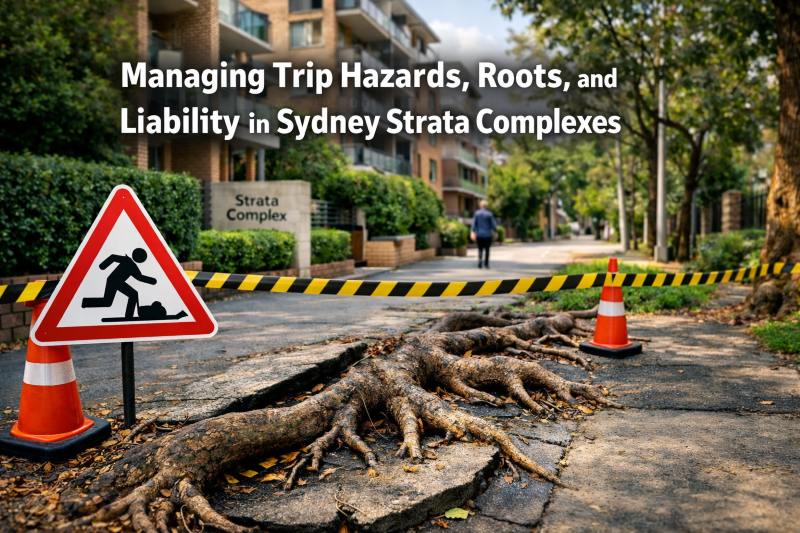
Trip hazards typically arise from uneven footpaths, lifted pavers, cracked concrete, or tree root upheaval. A proactive approach to trip hazard removal is essential for WHS compliance.
Critical Steps for Hazard Management
To ensure your complex is safe and compliant with Australian Standards, follow this workflow:
- Routine Safety Audits: Conduct inspections every six months, focusing on high-traffic zones like entryways, bin rooms, and pool surrounds.
- Photographic Reporting: Document surface changes. This condition reporting is vital evidence for insurance purposes.
- Slip-Rated Materials: Ensure all replacement works use materials that meet Australian Standard AS4586 (Slip resistance classification of new pedestrian surface materials).
- Immediate Remediation: Whether it is concrete grinding to level a surface or re-laying pavers, speed is key to liability mitigation.
Tackling Tree Root Damage in Strata Properties
Tree root damage in strata is a massive issue across Sydney, particularly in older complexes in the North Shore and Inner West where large native trees were planted decades ago. Roots can lift driveways, crack retaining walls, and penetrate stormwater pipes.
While trees add immense value and cooling to a property, unmanaged growth is a structural threat.
Best Practices for Tree Root Mitigation
- Engage an AQF Level 5 Arborist: Don’t just guess. Get a professional report to identify high-risk species and root zones.
- Root Barriers: Install physical barriers to deflect roots away from foundations and paths.
- Hydro-Excavation: Use non-destructive digging to locate roots without damaging pipes.
- Compliance: Ensure all pruning complies with your local Council and Sydney Water guidelines regarding infrastructure clearance.
Public Liability and Compliance in Landscaping
Every landscaping decision on common property has liability implications. Public liability landscaping requires evidence of risk assessment.
Note for Strata Managers: Ensure all contractors engaged for remediation carry valid Public Liability Insurance (minimum $20M usually recommended) and SafeWork NSW compliance documentation.
The Cost of Inaction vs. Proactive Maintenance
Many committees delay repairs to save the “Sinking Fund.” However, the financial risk of a personal injury claim far outweighs the cost of preventative maintenance.
| Approach | Old Method (Reactive) | New Method (Proactive) |
|---|---|---|
| Trigger | Only after complaints or accidents | Scheduled audits every 6 months |
| Root Strategy | Surface cutting (short-term fix) | Root barriers & Arborist planning |
| Insurance Risk | High (Negligence exposure) | Low (documented compliance) |
| 5-Year Cost | Escalating emergency repairs | Predictable, budgeted maintenance |
Long-Term ROI Through Landscape Compliance
Investing in safe, compliant landscapes directly protects both residents and asset value. A transparent maintenance program managed by professionals boosts property appeal, resale value, and long-term sustainability.
Why Choose Garden Managers?
We understand Sydney’s specific legal framework, soil conditions, and strata governance needs. We bridge the gap between horticultural beauty and strict WHS compliance.
Ready to secure your strata scheme?
Don’t wait for an accident to happen. Contact Garden Managers today for a comprehensive safety audit and landscape consultation.
Frequently Asked Questions (FAQ)
Who is responsible for tree roots damaging pipes in a strata scheme?
Generally, if the tree is on common property, the Owners Corporation is responsible for the repair of the pipes and the management of the tree.
What is the Australian Standard for walkway safety?
The primary standard is AS 4586, which covers slip resistance for new pedestrian surfaces. Strata schemes should aim to meet these standards during renovations or repairs.
Can we remove a tree that is causing a trip hazard?
You generally need council approval to remove trees over a certain size in Sydney. However, if the tree poses an immediate risk to human safety or property, an arborist can provide a report to expedite the council application process.