What a Horticultural Maintenance Tender Actually Requires — Sydney 2026
Most tender responses fail on the things nobody reads twice: the access window, the schedule of rates, and the documents you didn’t have to submit yet. Here’s what these contracts actually ask for.
Strata committees
Contractors
A horticultural maintenance tender in Sydney usually asks for eight to twelve separate documents, but only about half are required at submission. The rest — WHS management plan, insurance certificates, detailed SWMS — are typically only called for after award. The three things that decide the outcome are the schedule of rates, the access window, and whether you priced a Year 1 establishment program separately from the ongoing cycle. Sydney contracts commonly run $600–$1,100 a month for a small strata block and $2,000–$6,000+ for a large multi-building site, with a standard threshold of $10 million public liability cover.
A facility manager rang us in July about a three-year grounds contract she was about to put to market. She had a specification drafted by a predecessor who’d left, and she asked a reasonable question: was any of it still right?
It wasn’t, particularly. The specification asked for “regular garden maintenance to a high standard” and then listed a mowing frequency. No access window. No reactive works provision. No definition of what “high standard” meant, which is the phrase every dispute eventually turns on. It would have attracted a wide spread of prices that couldn’t be compared to each other, which is the worst outcome a tender can produce.
Horticultural maintenance contracts aren’t garden maintenance with a longer name. They’re procurement documents, and they behave like procurement documents — the money is decided by structure, not by enthusiasm. This is what’s actually in them.
What is horticultural maintenance, and how is it different from garden maintenance?
The distinction matters because it changes what you’re allowed to ask for.
Garden maintenance is a service: someone comes, mows, prunes, and leaves. Horticultural maintenance is a standard — the site is to be kept in a defined condition, and the contractor decides what work achieves that within an agreed frequency. The contract specifies the outcome and the inspection regime, not just the task list.
That’s why tender documents use the word. It signals that the buyer wants plant health managed, not just grass cut. It also signals that the contractor is expected to identify problems the buyer hasn’t noticed — dieback, drainage failure, structural issues in trees, irrigation zones that stopped working two summers ago.
For a facility manager, that’s the more useful contract. For a contractor, it’s the more demanding one, and it should be priced accordingly.
If you’re writing the specification
Define the standard, the frequency, and the inspection regime — then let the contractor price the method. Specifying both the standard and the exact task list at a fixed frequency is how you end up paying for work the site doesn’t need while the thing that actually needs attention sits outside scope.
What documents does a horticultural maintenance tender require?
This is where most bidders waste days. The full compliance pack for a grounds contract runs to a dozen documents, but a well-drafted tender only asks for a portion of them up front.
Usually required at submission
Public sector tenders in NSW are run through buy.nsw, which sets the document format before the buyer writes a word of it.
Usually only required after award
Read the submission checklist twice before building any of these. A WHS Management Plan is days of work, and a tender that asks for it at submission is rare.
The single most expensive line in a grounds tender is usually the one that looks administrative: the access window.
We’ve bid sites where the gate opens at 7:00am and all work must stop by 9:00am, every week, because the property opens to the public. That’s a two-hour working window. It doesn’t halve your productivity — it does considerably worse than that, because travel, set-up and pack-down don’t shrink. A job that would take one person a comfortable morning now needs a three-person crew moving fast, which changes your crew cost, your vehicle cost, and often your wage rate, since starting before 6am attracts a shift loading.
Add “no waste bins on site” and every barrow of green waste leaves in the truck, which eats the same window. We’ve seen bidders price those sites at an ordinary hourly rate and then discover the contract is unprofitable in month two. If you’re writing the specification, understand that a tight access window is the most expensive thing you can ask for — and if you’re bidding one, it belongs in your rate, not in your optimism.
How should the pricing schedule be structured?
A lump sum on its own is a trap for both sides. The buyer can’t compare bids that made different assumptions, and the contractor can’t recover work that falls outside them.
A workable schedule has three parts:
The fixed cycle
The scheduled maintenance visits that deliver the standard — priced per visit or annually, with a stated frequency and a stated number of visits per year. This is the number bids get compared on, so it has to cover the same scope for everyone.
The establishment phase
If the site has been neglected — and sites going to tender usually have been — the first year costs more than the steady state. Elevated visit frequency for the first several weeks until the standard is reached, then the normal cycle. Priced separately, or the contractor either loses money or quietly under-delivers.
The schedule of rates
Hourly rates, call-out minimums, after-hours rates, and a provision for reactive and storm works. These sit outside the lump sum by design. Storm damage is not a maintenance item and should never be buried in a fixed price.
Annual escalation belongs in the document too. A three-year contract written without a review mechanism is a three-year contract that gets worse every year — for the buyer as much as the contractor, because the contractor’s response is to reduce time on site.
| Site | Typical monthly contract value |
|---|---|
| Small strata block (under 20 units) | $600 – $1,100 |
| Medium complex (20–60 units) | $900 – $1,800 |
| Large complex / multi-building site | $2,000 – $6,000+ |
Ranges reflect Sydney sites in 2026. Access constraints, waste handling, irrigation complexity and tree cover move a site up its band quickly.
| Element | Our 2026 rate |
|---|---|
| Landscape gardener, hourly | $85/hr + GST |
| Minimum call-out (first hour) | $150 + GST |
| After-hours / emergency response | $135/hr + GST |
| Scheduled visit, working-at-heights site (quarterly) | $510/visit + GST |
| Failed access — no site entry available | 1.5-hour team minimum |
| Arborist inspection and report | Priced per site |
Published so you have a reference point when you compare bids. Rates are reviewed annually. If you’d rather model a whole site, our commercial grounds maintenance cost estimator works through it by size and frequency.
Putting a grounds contract to market? We’re happy to look over a draft specification before it goes out — no obligation, and we’ll tell you if it’s going to produce bids you can’t compare. Get in touch or call 0491 662 424.
What compliance obligations sit behind the paperwork?
Three areas catch contractors and buyers out in roughly equal measure.
Work health and safety
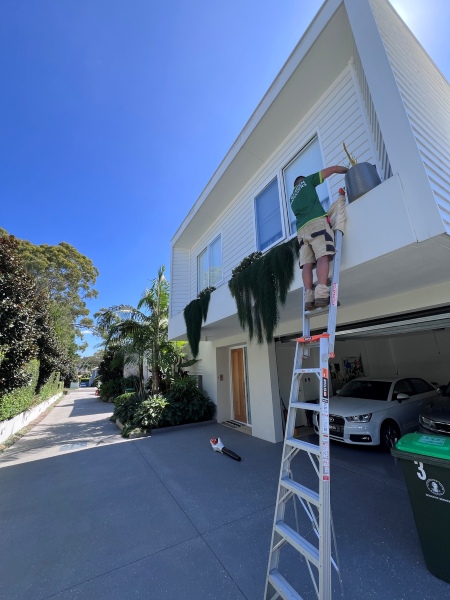
Safe Work Method Statements are required for high-risk construction work, and several ordinary grounds activities qualify — work at heights above two metres, work near powered plant, traffic management on a public frontage. SafeWork NSW sets out which activities trigger the requirement; the obligation sits with the person conducting the business, which is the contractor, but the principal has duties too. See SafeWork NSW.
Pesticides and herbicide use
Whether a pesticide applicator licence is required in NSW depends on what’s being applied and in what setting — amenity horticulture sits differently from agricultural or public-space application, and the answer is not the same for every contractor. Record-keeping obligations apply regardless. Confirm your own position with the NSW EPA before you tender rather than after you’ve won. Many specifications also require public notice signage — commonly 48 hours — before any application on a site the public can access.
Strata sites specifically
If the site is strata, the owners corporation has a duty under section 106 of the Strata Schemes Management Act 2015 to maintain common property in good repair. That duty doesn’t transfer to the contractor, but a contractor’s reporting is often the only evidence the committee has that it was discharged. From July 2025 the limitation period for claims extended to six years, which makes contemporaneous records considerably more valuable than they used to be.
This is general information about how these contracts are structured, not legal advice. For a specific contract or dispute, get advice from a qualified professional.
What is a horticultural assessment, and should it be in the contract?
This is the part most specifications leave out, and it’s the part that saves buildings the most money.
We include a horticultural assessment as part of our post-completion reporting. It’s not a task list of what was done — it’s a record of what the site’s plants, soil and systems were actually like on the day, written by the person who was standing in it. Plant health and dieback, soil and drainage condition, irrigation zones tested and their status, structural issues in trees and shrubs, and anything trending in the wrong direction that will become a cost if it’s left.
The reason it belongs in a contract is that grounds problems are slow. Nothing fails on a Tuesday. A drainage issue presents as a patchy lawn for two seasons before it presents as a dead lawn, and by then the fix is earthworks rather than a repair. A committee reading twelve months of assessments sees the trend; a committee reading twelve months of visit reports sees twelve identical lists of tasks.
A Vaucluse building’s long-serving gardener retired with no handover documentation — no site inventory, no maintenance schedule, no record of what had been done or when. We built the management plan from scratch, starting with a full assessment of the site.
That initial assessment found two irrigation zones that weren’t running at all, a partially blocked drain, and three shrubs overgrown to the point of needing structural pruning rather than a trim. None of it was visible as a complaint. None of it was in any document. All of it was going to cost materially more in twelve months than it cost that week.
The committee signed the same week — at a higher price than they had been paying — because for the first time they could see what they owned.
If you’re writing a specification, ask for it explicitly: a written horticultural assessment at defined intervals, with photographs, covering plant health, soil, drainage and irrigation. It costs very little to require and it’s the difference between a maintenance contract and an asset management one. Our grounds asset and facility management service is built around exactly this reporting structure.
What separates a compliant bid from a competitive one?
Compliance gets you assessed. It doesn’t get you selected. Across the tenders we’ve responded to, the bids that win tend to differ in four ways.
They answer the site, not the template
A methodology that could apply to any property reads as though nobody attended the site inspection. Name the actual zones, the actual constraints, the actual problems visible on the day.
They price Year 1 honestly
Neglected sites need an establishment phase. Bids that pretend otherwise are either underpriced or planning to under-deliver, and experienced assessors know which.
They show the reporting
Include a real sample report. Assessors are buying evidence as much as labour, and a sample is worth more than a paragraph promising one.
They name their subcontractors
Tree work usually needs a consulting arborist. Naming a firm with AQF Level 5 qualifications and TRAQ or QTRA methodology is stronger than “arborist engaged as required”.
The mistake we see most often
Bidders answer the evaluation criteria in the order the criteria are listed and never state a price assumption. Then a dispute arrives in month four about whether storm clean-up was included. Write your assumptions down — what’s in the lump sum, what’s on the schedule of rates, and what triggers the difference. A buyer who disagrees will tell you before you’re contracted, which is the cheapest time to find out.
What should a facility manager put in the specification?
If you’re on the buying side, the document only needs to do six things well.
- Define the standard in terms you could photograph — not “high standard”, but what the turf, beds and edges should look like between visits.
- State the access window precisely, including waste removal, parking and any public-hours restriction. This drives the price more than anything else in the document.
- Separate establishment from steady state so you can see both numbers and compare bids on a common basis.
- Require a schedule of rates for reactive and after-hours work, with a stated response target — 24 hours is common for storm and safety works.
- Specify the reporting, including a written horticultural assessment at defined intervals with photographs.
- Set the inspection regime — monthly joint inspections work well, and they resolve standard disputes before they become contract disputes.
For strata committees running this process rather than a professional FM, the approval pathway matters as much as the document. We’ve covered that separately in how to get committee approval for a new garden contractor, and the budget side in the 10-year capital works plan template.
Frequently asked questions
How much public liability insurance does a horticultural maintenance tender require?
Ten million dollars is the standard threshold for grounds maintenance contracts in Sydney, and it’s what most public sector, strata and commercial specifications ask for. Some larger institutional sites ask for twenty million. Workers compensation cover is required separately and is not optional for any business with employees in NSW.
Certificates of currency are usually only required after award rather than at submission, so check the submission checklist before you spend time gathering them. What you normally need to do at tender stage is simply confirm the level of cover you hold.
Do I need a licence to apply herbicide under a grounds maintenance contract in NSW?
It depends on what you’re applying and in what setting. Amenity horticulture is treated differently from agricultural or public-space application under the NSW pesticides framework, and the answer is not the same for every contractor or every site. Record-keeping obligations apply regardless of whether a licence does.
Confirm your own position directly with the NSW EPA before you tender, not after you’ve won the contract. Separately, many specifications require public notice signage — commonly 48 hours ahead — before any application on a site members of the public can access, and that requirement is contractual rather than regulatory, so it applies whatever your licensing position.
Should storm damage be included in the fixed monthly price?
No. Storm and emergency works should sit on the schedule of rates, outside the lump sum, with a stated response target. Twenty-four hours is a common target for safety-related works. Burying unpredictable work in a fixed price forces the contractor to either pad the monthly figure or absorb the risk, and neither outcome serves the building.
What the contract should include is the rate, the response time, and a threshold above which the contractor must seek approval before proceeding. That way an urgent hazard gets cleared immediately and a larger job still goes through the building’s approval process.
Why does a neglected site cost more in the first year?
Because the crew is clearing a backlog rather than maintaining a standard. Overgrown beds, accumulated weed seed, unpruned structure and failed irrigation all take time to bring back, and until they’re back, every ordinary visit is slower than it should be. An establishment phase of elevated visit frequency resolves it, typically over the first several weeks.
Once the site reaches standard, the ongoing cycle costs less and delivers more. We’ve had clients tell us that regular maintenance took noticeably less time after a proper initial clean-up, simply because the crew stopped fighting a backlog on every visit. Pricing the establishment phase separately makes that visible in the tender rather than hidden in an inflated monthly rate.
What is a horticultural assessment and how often should it be done?
It’s a written record of the site’s actual horticultural condition — plant health and dieback, soil and drainage, irrigation zones tested and their status, and structural issues in trees and shrubs — as distinct from a list of tasks completed. We provide it as part of post-completion reporting, with photographs.
Quarterly works well for most strata and commercial sites, with a more detailed assessment annually. The value is in the sequence rather than any single report: reading four quarters together shows a committee what is trending, which is how drainage and irrigation problems get caught while they are still repairs rather than replacements.
Can a small contractor win a horticultural maintenance tender against a large one?
Regularly, yes. Assessors are weighing risk, and a smaller contractor with directly employed crews, named supervision and genuinely comparable referee sites often presents less risk than a large firm subcontracting the work to whoever is available that week. Who actually attends the site is a fair question and it gets asked.
Where small contractors lose is documentation and follow-through — a thin methodology, referee sites that aren’t comparable, or no sample reporting. Those are fixable without scale. The parts that genuinely need scale, such as consulting arborists, are normally handled by naming a qualified subcontractor rather than employing one.
References
- SafeWork NSW — Safe Work Method Statements and high-risk construction work
- NSW EPA — Pesticides — licensing, training and record-keeping requirements
- Strata Schemes Management Act 2015 (NSW) — section 106, duty to maintain common property
- buy.nsw — NSW Government procurement framework
Reviewing or writing a grounds contract?
We work with strata committees, building managers and facility managers across Sydney’s Eastern Suburbs — and we’ve been on the contractor’s side of enough tender documents to know what makes them work. Fixed-price scheduled maintenance, written horticultural assessments with photographs, $10M public liability, registered on SMATA.
Happy to review a draft specification before it goes to market, or to quote against one you’ve already issued.
Garden Managers
Strata, commercial and residential grounds maintenance across Sydney’s Eastern Suburbs since 2016. 5.0 stars across 50+ Google reviews. $10M public liability, NSW workers compensation, SMATA registered.
Read more on strata garden maintenance, grounds control for strata sites, or what a commercial grounds contract should include.