Case Study: Restoring a Neglected Irrigation System at a 30-Unit Strata
The irrigation had been switched off at the master valve to stop a leak. Nobody turned it back on. By the time we were called, plants were dying and the system had six separate faults — most of them cut lines nobody knew about.
6 faults found
1.5 days on site
Full system restored
A 30-unit Eastern Suburbs strata building had no working irrigation — the master valve feed had broken and been shut off to stop the leak, and was never turned back on. Plants were dying. On inspection we found six faults: the broken master valve feed, a blocked station, cut sprinklers, drip line cut in multiple locations, and severed 19mm poly. The main leak was found and fixed within the first 2–3 hours; the full restoration took 1.5 days and cost approximately $3,000. A two-week follow-up confirmed the system was running correctly, with visible regrowth across the beds.
What we walked into
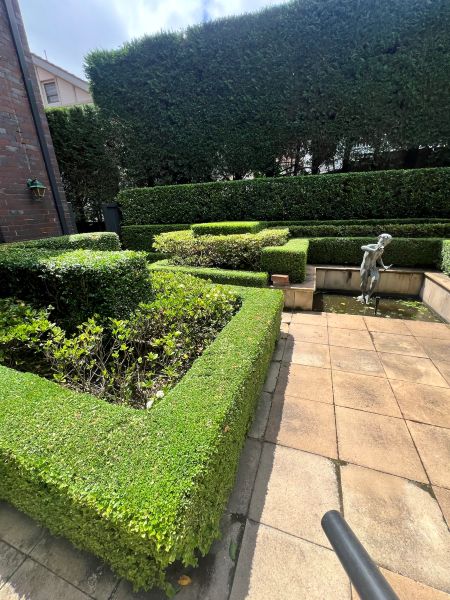
The building was relatively new but the garden had been neglected. That combination is more common than people expect — a scheme changes managing agents, or the original landscaper finishes their defects period and moves on, and the grounds quietly fall through the gap.
The visible problem was dead plants. The reported problem was an irrigation leak at the master valve. Those two facts were connected, but not in the way anyone had assumed.
The master valve feed had broken at some point and was leaking continuously. Someone — reasonably enough — had shut it off to stop the water loss. That was meant to be a temporary measure until it got fixed.
It never got fixed. And with the master valve closed, the entire irrigation system was dead. Not one zone running anywhere on a 30-unit property. The plants weren’t dying because of a leak; they were dying because nothing had watered them in a long time.
A temporary shut-off that nobody revisits is one of the most common ways a strata property ends up with no irrigation at all. It doesn’t look like a failure — the leak stopped, the immediate problem went away, and there’s no alarm or error message telling anyone the system is off. The symptom only appears months later, as dead plants, by which point the cost has moved from a valve repair to a replanting bill.
The site meeting and quote
We did a free 30-minute site meeting to look at the system and understand the scope before quoting. That’s worth doing properly on a job like this — the reported fault (a leaking master valve) turned out to be one of six problems, and quoting on the reported fault alone would have meant coming back with bad news later.
The six faults
We worked through the system methodically rather than stopping at the first fault. Here’s what was actually wrong.
The original reported problem, and the reason the whole system had been shut down. Until this was repaired, nothing else could be tested, because there was no way to pressurise the system without reopening the leak.
One zone wasn’t passing water even once the system was live. Blockages at station level are easy to misread as a controller or wiring fault, because from the surface the symptom is identical — that zone simply doesn’t run.
Several sprinklers had been physically cut. Once the system was pressurised these became obvious — water going straight into the ground rather than over the garden.
Not one break — several, across different areas of the property. Drip line sits shallow in garden beds, which makes it the most vulnerable component on any strata system.
A main distribution line cut through. This one matters more than a cut dripper because everything downstream of it loses supply — a single break here can take out a large section of garden.
Once the system was under pressure again, additional leak points showed themselves. This is why the job ran to 1.5 days rather than a single visit — you can only find pressure-dependent faults once there’s pressure in the lines.
Look at faults three, four and five together: cut sprinklers, cut drip line in several places, and severed 19mm poly. That’s not wear and tear, and it’s not one accident. It’s the signature of garden work done by someone who didn’t know where the lines were — digging, edging, or planting straight through shallow irrigation. We see it regularly on properties where maintenance has changed hands without any documentation of the system being passed on. Nobody does it deliberately. They just have no way of knowing what’s under the mulch.
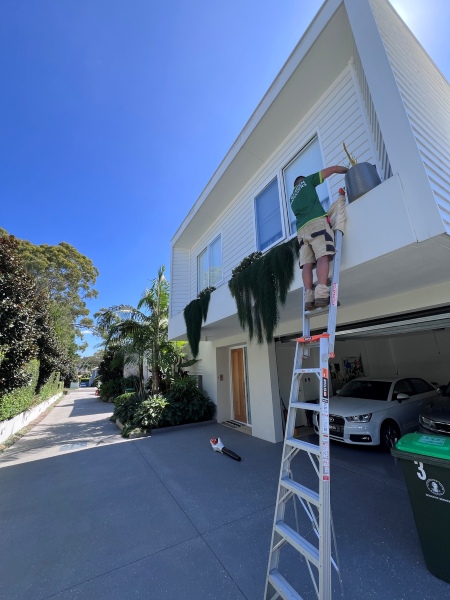
How the repair ran
What it cost, and why
The full restoration came to approximately $3,000. That’s well above a standard irrigation repair, and the reason is scope rather than rate — this was a large system across a 30-unit property with damage in multiple locations, not a single fault.
| Item | Detail |
|---|---|
| Site meeting and quote | Free (30 min) |
| Master valve feed repair | First 2–3 hours on site |
| Full system repair | 1.5 days total, parts and labour |
| Two-week follow-up visit | Included |
| Total | ~$3,000 |
For context, our standard irrigation service and seasonal adjustment is $180–$380, and a small strata system replacement (2–3 zones) runs $1,800–$3,500. This job sat where it did because of system size and the number of separate repairs required.
What the alternative was
Without the repair, the building had no irrigation. The practical alternative for a 30-unit complex is hand watering — which means either paying someone to do it or relying on residents, neither of which is realistic across an entire common property garden through a Sydney summer.
The other cost was already being paid in dead plants. Replanting established garden beds on a property that size is a significant expense, and it recurs every time the cycle repeats.
Where it landed
The outcome that matters most isn’t the repair itself — it’s that the property now has a system that can be maintained. Before this job there was nothing to service: the system was off, its condition unknown, and any maintenance visit would have been guesswork.
Now every zone is documented and working, which means seasonal servicing takes a couple of hours rather than a day of diagnosis, faults get caught early instead of after plants die, and the owners corporation has a known asset rather than an unknown liability.
Has anything been “temporarily” shut off? Isolation valves closed to stop a leak are the single most common cause of a dead irrigation system. There’s no alarm — you have to look.
Does anyone have a zone map? If garden work is being done by people who don’t know where the lines run, cut drip line and severed poly are close to inevitable.
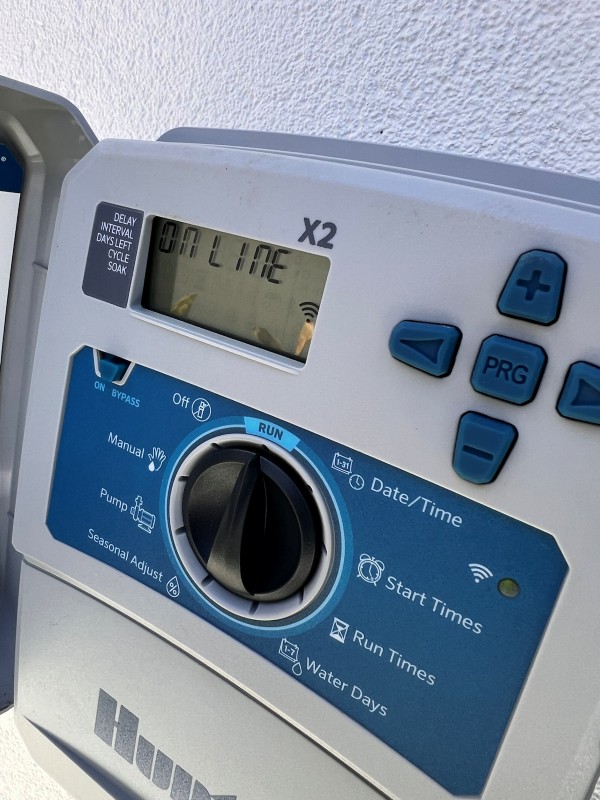
When was the system last actually run? Not “is it scheduled” — has someone physically watched every zone run in the last six months? Systems fail silently.
Frequently Asked Questions
How much does it cost to repair a strata irrigation system in Sydney?
It depends entirely on scope. A standard service and seasonal adjustment is $180–$380. A single fault such as a controller replacement runs $420–$1,100, and a valve manifold replacement $500–$1,300. A full restoration of a large neglected system, like the 30-unit property in this case study, came to approximately $3,000 across 1.5 days.
The main variable is how many separate faults exist. One fault is a service call. Six faults across a large distribution network is a project.
Why do irrigation systems on strata properties fail without anyone noticing?
Because irrigation fails silently. There’s no alarm, no error message, and no single person responsible for watching it run. Systems are typically scheduled to run early morning or after 4pm when nobody is watching the garden, so a zone can stop working for months before the symptom — dead or stressed plants — becomes visible.
The failure mode in this case study is particularly common: a valve closed temporarily to stop a leak, and never reopened. The immediate problem disappears, so nobody follows up, and the whole system stays off.
What causes cut irrigation lines in garden beds?
Almost always garden work carried out without knowledge of where the lines run. Drip line sits shallow in garden beds and 19mm poly isn’t much deeper, so digging, edging, planting or bed renovation can sever them easily. It’s rarely deliberate — whoever is working simply has no way to know what’s under the mulch.
The risk is highest on properties where maintenance has changed contractors without any documentation of the irrigation layout being handed over. A zone map is the practical protection.
Can a neglected irrigation system be repaired, or does it need replacing?
In most cases it can be repaired. In this project the system was fully restored rather than replaced, despite six separate faults, because the underlying infrastructure — mainline, stations and controller — was sound. What had failed were repairable components and cut distribution lines.
Replacement generally becomes the better option when pipework itself has degraded throughout, when the original design no longer matches the planting, or when repair costs approach the cost of a new system. A documented irrigation audit ($280–$580 for strata) is the way to establish which situation you’re in before committing either way.
Not sure whether your strata irrigation is actually running?
We’ll walk the site, run every zone, and tell you honestly what’s working, what’s broken, and what it costs to fix. Free site assessment across Sydney’s Eastern Suburbs.