A practical field guide for strata committees, body corporates, and homeowners managing irrigation failures in Greater Sydney — with current pricing data, compliance requirements, and seasonal action plans for 2026.
A burst solenoid valve at 7am on a Monday. A strata committee member forwarding photos of waterlogged garden beds. A quarterly water bill that’s jumped by $400 and nobody can explain why. These aren’t hypothetical scenarios — they’re the three most common ways Sydney property managers discover an irrigation system failure, and each one triggers a chain of damage that accelerates by the day.
In a city where IPART has approved water price increases of 13.8% for 2025–26, and where Water Wise Guidelines restrict how and when you can water, a leaking irrigation line isn’t just an inconvenience — it’s a compliance risk, a financial drain, and a threat to the landscape assets your property depends on for value.
This guide covers exactly what to do when your irrigation system fails, how Sydney’s current water rules affect your repair options, what a modern fix actually costs versus a band-aid repair, and how strata schemes can stay compliant under the updated Strata Schemes Management Act 2015.
How to Tell Your Irrigation System Has Failed (Before Your Water Bill Tells You)
Most irrigation failures don’t announce themselves dramatically. They develop gradually, and the signs are easy to dismiss until damage has compounded. Here’s what property managers and homeowners in Sydney should actually look for — ranked by how quickly each issue causes financial or horticultural harm:
Unexplained water pooling or soft, spongy ground — especially around valve boxes, pipe junctions, or retaining walls. This usually signals a cracked mainline or a failed fitting below the surface. Left unaddressed, it can undermine hardscaping and create trip hazards on strata common areas.
A sudden, sustained drop in water pressure across multiple zones — if more than one zone is weak at once, the issue is likely upstream: a failed backflow preventer, a cracked manifold, or a supply-side leak. A single weak zone usually means a broken lateral line or blocked nozzles.
Zones running continuously or failing to shut off — this points to a solenoid valve stuck open (usually caused by debris in the diaphragm) or a controller malfunction. During Sydney’s Water Wise hours, a stuck-open zone can put you in breach of watering rules and rack up hundreds of litres in waste before anyone notices.
A spike on your water meter when all taps are off — walk outside, shut off every tap and appliance in the property, and read your water meter. Wait 30 minutes and read it again. If it’s moved, you have a leak somewhere in your system.
Medium-urgency indicators (address within 1–2 weeks): Uneven spray patterns, dry patches appearing in previously healthy turf, misting from sprinkler heads (a sign of excessive pressure or worn nozzles), and automated zones that skip or run at incorrect times. These issues cause slow damage but accelerate significantly during Sydney’s hot western-suburbs summers, where soil moisture can drop critically within days.
Not Sure If It’s an Emergency?
Our irrigation specialists can diagnose the issue remotely or on-site across Greater Sydney — strata and residential.
What to Do Right Now: A Step-by-Step Emergency Response
Whether you’re a strata committee chair, a building manager, or a homeowner staring at a flooded garden bed, here’s the sequence that minimises damage and cost:
- Isolate the water supply to the irrigation system
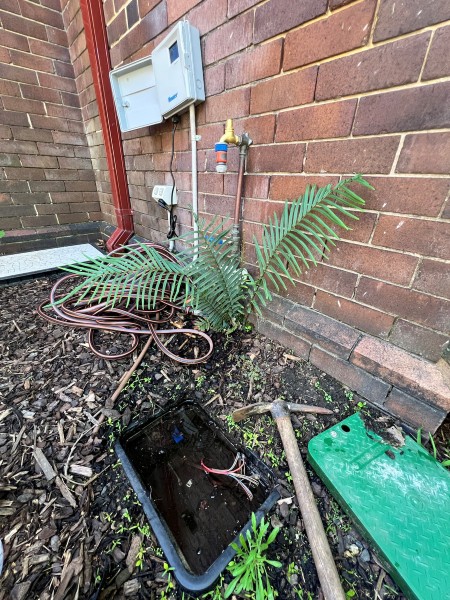
Locate the irrigation isolation valve — this is separate from your property’s main water shut-off. In strata schemes, it’s typically near the water meter bank or in a valve pit within the common-area garden. Close it fully. If multiple common areas share a valve, notify residents via your building’s communication channel before shutting down to avoid complaints. Don’t shut off the main property supply unless you suspect the leak is upstream of the irrigation isolation point. - Document the damage for reporting and insurance
Take timestamped photos of visible leaks, water pooling, damaged plants, and any infrastructure affected (paths, retaining walls, building foundations). For strata properties, this documentation supports your Executive Committee or Body Corporate when fast-tracking approval for urgent maintenance works. Under Section 106 of the Strata Schemes Management Act 2015, the Owners Corporation has a strict duty to maintain common property — and the 2025 legislative amendments have extended the window for owners to claim losses from maintenance failures from 2 years to 6 years. - Read your water meter and note the current figure
This gives you a baseline to quantify the leak once it’s repaired. If your strata scheme receives quarterly bills, this reading helps isolate the waste to a specific period and supports any application for a leak allowance from Sydney Water. - Engage a licensed irrigation specialist — not a general plumber
Irrigation systems have components that general plumbers rarely work with: solenoid valves, controller wiring, pressure-regulated heads, drip emitters, backflow prevention devices, and weather-based sensors. A specialist can trace hidden leaks using acoustic detection or pressure testing, recalibrate controllers, and advise on smart system upgrades that comply with Sydney’s Water Wise Guidelines. - Review your controller and system age
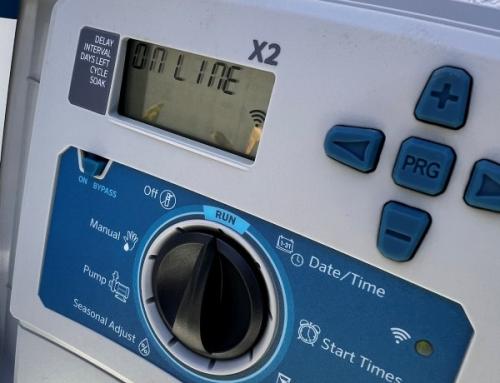
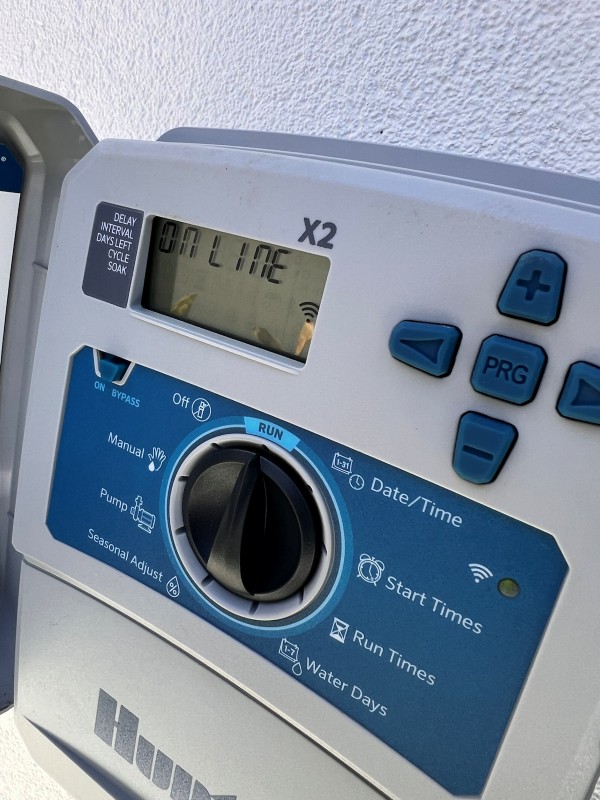
If your system is running an electromechanical controller or hasn’t been upgraded in over 8 years, the emergency repair is an opportunity to discuss a technology upgrade. Weather-based smart controllers (like Hunter’s Hydrawise platform) adjust watering schedules automatically based on real-time Sydney weather data, which directly reduces waste and keeps you compliant with water restrictions without manual intervention.
Sydney’s Current Water Rules and What They Mean for Your Irrigation System
Sydney’s Water Wise Guidelines apply year-round to every property in Greater Sydney, the Blue Mountains, and the Illawarra. These aren’t optional best-practice tips — they’re mandatory rules, and fines apply for breaches (up to $220 for individuals, $550 for businesses).
Sprinklers and watering systems may only operate before 10am and after 4pm on any day.
Smart watering systems and drip irrigation (systems with automated weather adjustment, rain sensors, or soil moisture sensors) may operate between 10am and 4pm — this is a significant advantage for properties with upgraded controllers.
Hoses must have a trigger nozzle fitted and must never be left running unattended.
Hosing of hard surfaces (paths, driveways, concrete) is prohibited unless required for safety or emergency reasons.
If dam levels drop below 60%: higher drought-rate pricing applies automatically, and additional restrictions may be triggered. Smart systems that reduce consumption give you a buffer against these cost spikes.
Exemption note: Recycled water (purple pipe), rainwater (from tanks not topped up by mains), greywater, and bore water are exempt from these guidelines.
The practical takeaway: A faulty irrigation system running outside permitted hours, or a stuck valve operating mid-afternoon, isn’t just wasteful — it’s a compliance breach that can result in fines if observed by Sydney Water’s Community Water Officers. This is especially relevant for strata properties where common-area gardens are visible to the public.
Sydney’s Seasons and Your Irrigation: When Problems Hit Hardest
Sydney’s climate is deceptively variable. The assumption that it’s “warm and temperate” year-round leads many property managers to set-and-forget their irrigation — which is exactly how failures compound. Here’s what actually happens season by season, and what your system needs at each stage:
Summer (Dec–Feb)
Peak stress period. Western Sydney regularly exceeds 40°C. Soil moisture drops critically within 48 hours of a system failure. UV degrades exposed PVC fittings, and thermal expansion cracks pipe joints. This is when most emergency call-outs happen — and when every day of delay kills plants. Demand on the supply side spikes, so water pressure fluctuations can also expose weak points in ageing systems.
Autumn (Mar–May)
Ideal audit window. Cooling temperatures reduce urgency but create the best conditions for system inspections and upgrades. Root intrusion from deciduous species becomes visible. This is the most cost-effective time to schedule preventive maintenance — contractors have availability, and you can resolve issues before winter dormancy without plant loss.
Winter (Jun–Aug)
Low demand, hidden damage. Systems often sit dormant, but leaks continue underground unnoticed. Winter is when electrical faults in solenoid wiring develop (moisture ingress into junction boxes). Freezing is rare in metro Sydney but occurs in Blue Mountains and upper North Shore areas — damaged fittings from frost can go undetected until spring start-up.
Spring (Sep–Nov)
Critical restart. Reactivating a dormant system without inspection risks flooding from winter-damaged components. This is when strata committees should be commissioning a full system test: pressure checks, nozzle inspections, controller recalibration, and sensor verification — before summer demand hits.
Managing Multiple Strata Properties Across Sydney?
We provide scheduled quarterly maintenance programs for strata bodies — from the Eastern Suburbs to Western Sydney.
What Emergency Irrigation Repair Actually Costs in Sydney (And Where the Real Money Goes)
The repair itself is rarely the expensive part. It’s the water waste before the repair, the plant replacement afterwards, and the repeat call-outs from patching instead of fixing properly. Here’s how the numbers typically break down for a mid-sized strata common area in 2026:
| Scenario | Reactive Repair Approach | Proactive Asset Management |
|---|---|---|
| Leak detection and repair | Fix visible leak only: ~$250–$500 per call-out. Hidden leaks upstream often missed. | Full pressure test + acoustic detection: ~$400–$800 upfront, identifies all issues at once. |
| Annual water waste from undetected leaks | 9,000L/week × 52 weeks = ~468,000L wasted. At $3.90/kL = ~$1,825/year in excess charges. | Smart flow sensors detect anomalies within hours. Potential waste reduced by 85–95%. |
| Controller and scheduling | Manual timer adjustments, no weather compensation. Staff must reprogram seasonally. | Smart controller (e.g., Hunter Hydrawise) auto-adjusts using BOM data. Compliant with Water Wise daytime exemption for smart systems. |
| Sprinkler heads and emitters | Replace broken heads as they fail: $15–$40 each + call-out. Mismatched heads cause uneven coverage. | Zone-matched, pressure-regulated heads (e.g., Hunter I-20 rotors or MP Rotators) installed across entire zone for uniform distribution. |
| Plant and turf replacement | Reactive replacement after dieback: $800–$3,000+ per incident depending on garden size and species. | Preventive watering maintains root zone health. Near-zero unplanned replacement costs. |
| 3-year total cost estimate (mid-size strata garden) |
$8,000–$15,000+ including repeat call-outs, wasted water, and plant losses. | $3,500–$6,000 including upfront upgrade and quarterly servicing contract. |
The numbers aren’t theoretical. Strata committees managing multiple properties across Sydney consistently report that moving from reactive to planned maintenance cuts their combined irrigation spending by 40–60% within the first two years — while improving garden presentation scores in property valuations.
Strata Compliance: Why Ignoring Irrigation Repairs Creates Legal Exposure
For strata properties in New South Wales, irrigation infrastructure on common property falls under the Owners Corporation’s maintenance obligations. The legal framework is clear and has been significantly strengthened by recent reforms:
Section 106 of the Strata Schemes Management Act 2015 imposes a strict duty on the Owners Corporation to properly maintain and keep in a state of good and serviceable repair all common property. This includes garden infrastructure, irrigation pipework, controllers, and associated electrical components.
The Strata Schemes Legislation Amendment Act 2025 extended the limitation period for Section 106 claims from 2 years to 6 years. This means an owner who suffers loss because the Owners Corporation failed to repair common-area irrigation infrastructure can now pursue a claim up to 6 years after the failure.
Strata committee members now have expanded duties of care and diligence — including mandatory training requirements. Documented neglect of maintenance obligations could be used as evidence in a Section 106 claim.
Unfair contract terms in standard-form strata service agreements are banned from 1 July 2025 — meaning your maintenance contracts should be reviewed to ensure they don’t limit the contractor’s liability unreasonably.
The practical implication: a strata committee that receives reports of irrigation failure and delays action isn’t just risking garden damage — it’s creating a documentable trail of non-compliance that any lot owner could use in a claim for up to six years.
Smart Irrigation Technology That Actually Pays for Itself in Sydney
Technology upgrades are only worth discussing if they deliver measurable returns. In Sydney’s regulatory and climate context, three upgrades consistently deliver ROI within 12–18 months:
1. Weather-Based Smart Controllers
Systems like Hunter Hydrawise pull real-time weather data from the Bureau of Meteorology and adjust watering schedules automatically. In practical terms, this means the system skips watering after rain, reduces run times during cool periods, and increases them during heatwaves — without anyone touching the controller. Critically for Sydney properties, smart controllers qualify for the daytime watering exemption under Water Wise Guidelines, meaning drip systems can operate between 10am and 4pm. This gives you far more scheduling flexibility than manual timers.
2. Flow Sensors and Leak Detection
A flow sensor installed on the irrigation mainline monitors water usage in real time and sends alerts if flow exceeds expected parameters — catching leaks within hours instead of weeks. For strata properties where garden areas may not be visually inspected daily, this is the single most cost-effective upgrade available. Hunter’s HC flow meters integrate directly with Hydrawise controllers.
3. Pressure-Regulated, Matched-Precipitation Heads
Older systems frequently have mismatched sprinkler heads within the same zone — pop-up sprays next to rotors, for example — which creates wildly uneven distribution. Replacing these with matched-precipitation-rate heads (like MP Rotators) ensures every square metre receives the same amount of water, eliminating dry spots and overwatered patches simultaneously.
Get a System Assessment Tailored to Your Property
We audit, repair, and upgrade irrigation across strata complexes, commercial landscapes, and residential gardens throughout Greater Sydney.
Building a Maintenance Plan That Prevents Emergencies
Emergency repairs are a symptom of absent maintenance planning. For strata schemes and larger residential properties, a structured quarterly program eliminates the majority of urgent call-outs and provides budget predictability:
Quarterly inspection cycle for Sydney properties:
Q1 (July–September) — Winter dormancy check: Inspect valve boxes for water ingress, test solenoid wiring continuity, verify controller battery backup and programming, clear debris from filter screens and emitters. Low system demand makes this ideal for non-disruptive repairs.
Q2 (October–December) — Spring activation and summer prep: Full system pressure test, nozzle inspection and replacement, controller recalibration for summer schedules, sensor verification (rain and soil moisture), and coverage uniformity audit. This is the most critical inspection of the year.
Q3 (January–March) — Peak performance monitoring: Mid-summer check for stress indicators, flow sensor data review, water usage benchmarking against previous years, and quick-response repairs for any heat-related failures. Focus on keeping the system performing through the highest-demand period.
Q4 (April–June) — Autumn wind-down and upgrade planning: System performance review for the year, capital works recommendations for committee budgeting, scheduling of off-season upgrades, and digital mapping updates for any infrastructure changes.
Frequently Asked Questions
How quickly can an irrigation leak damage plants in Sydney’s climate?
It depends on the season and the species. During a Western Sydney summer heatwave (40°C+), turf and shallow-rooted plants can show visible stress within 48–72 hours of irrigation loss. Established native plantings are more resilient — typically 1–2 weeks — but even they suffer root damage if the soil dries to depth. The financial risk is equally fast: a moderate leak can waste 9,000 litres per week, adding measurable costs to your water bill within a single billing cycle.
Can my strata committee approve emergency irrigation repairs without a general meeting?
Yes, in most cases. Under the Strata Schemes Management Act 2015, urgent repairs to common property that prevent damage or comply with safety and statutory obligations can be authorised by the strata committee without waiting for a general meeting. Document the urgency, obtain at least two quotes where practical, and minute the decision. Given the extended 6-year claim window under the 2025 amendments, thorough documentation of timely action is especially important for protecting committee members.
Are smart irrigation controllers worth the investment for a residential property?
For most Sydney residential properties with an established garden, yes. A smart controller like Hunter Hydrawise costs around $350–$600 installed, and typically reduces water consumption by 20–40% through automatic weather adjustment and seasonal scheduling. At Sydney’s current water pricing, a garden using 200kL/year could save $200–$400 annually. The controller also qualifies your drip systems for daytime watering under Water Wise Guidelines, giving you more scheduling flexibility. Payback is usually within 12–18 months.
What’s the difference between a plumber and an irrigation specialist?
A licensed plumber handles potable water supply, drainage, and gas fitting. An irrigation specialist focuses on the design, installation, and repair of irrigation-specific infrastructure: solenoid valves, programmable controllers, drip and spray systems, backflow prevention devices, weather sensors, and hydraulic design for uniform coverage. While a plumber can fix a leaking pipe, an irrigation specialist can diagnose why an entire zone is underperforming and optimise the system for water efficiency and compliance. For anything beyond a simple pipe repair, a specialist will usually save you time and money.
Does Sydney Water offer a rebate or allowance for water lost through leaks?
Sydney Water offers a concealed leak allowance for water lost through hidden leaks that couldn’t reasonably have been detected. To qualify, you need to provide evidence that the leak was concealed (not visible), show the repair has been completed by a licensed professional, and apply within the eligible period. Your water meter reading before and after the repair supports the claim. Check Sydney Water’s website for current eligibility criteria, as conditions are updated periodically.
Related Services
Protect Your Property Before the Next Sydney Summer
Whether it’s an emergency repair or a proactive upgrade plan, our team is ready to help strata committees and homeowners across Greater Sydney.