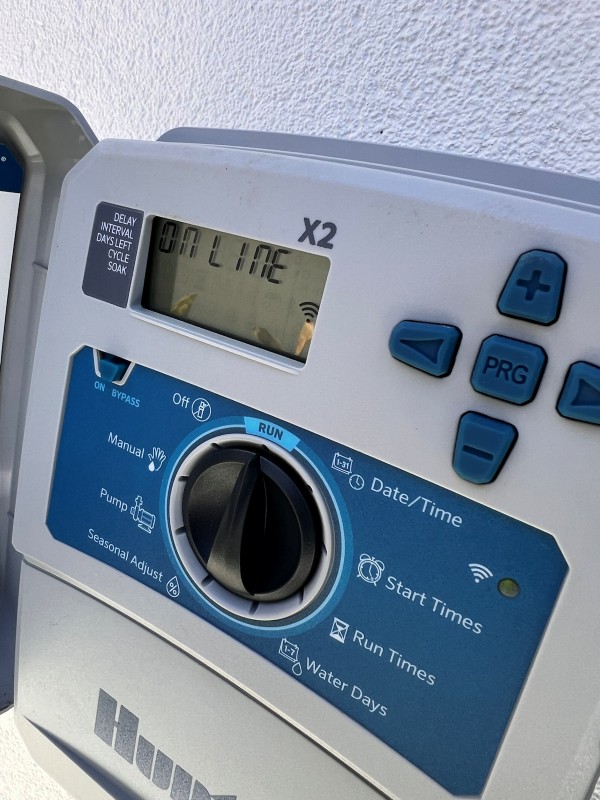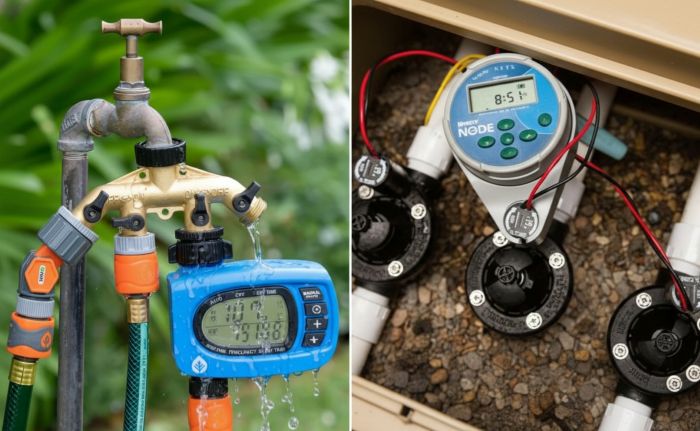
For Sydney property managers, strata committees, and homeowners, the best irrigation controller is a Wi-Fi-enabled “smart” controller. Unlike cheap battery-operated tap timers, a smart controller uses real-time local weather data, plant types, and soil information to automatically adjust watering schedules, saving 30-50% on water bills and ensuring full compliance with Sydney’s water restrictions.
Choosing a controller isn’t just about convenience; it’s a critical financial and horticultural decision. A “set and forget” tap timer is one of the fastest ways to waste thousands of dollars and destroy a valuable garden asset.
This guide breaks down the technology, the costs, and the critical differences for Sydney properties.
What is a Smart (Wi-Fi) Irrigation Controller?
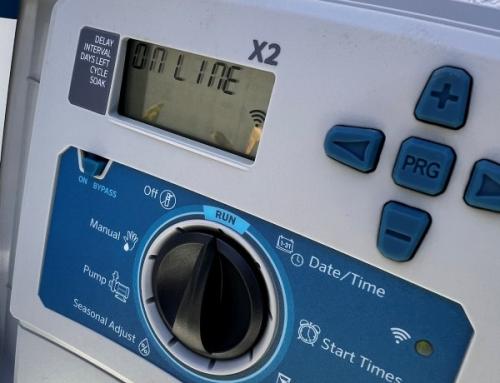
A smart irrigation controller is a main-powered, professional unit that connects to your property’s Wi-Fi. It replaces your old, clunky dial-and-button controller.
Its “smart” functions come from multiple data inputs:
-
Weather-Based Adjustments: Instead of watering in the rain, a smart controller pulls data from local weather stations (often via the Bureau of Meteorology). If it rains, it automatically skips the next cycle. If a 40°C heatwave is forecast, it will intelligently apply water before the stress hits.
- Evapotranspiration (ET) Data: This is the key. ET is the combination of water evaporating from the soil and transpiring from the plants. Smart controllers track this daily and only apply the exact amount of water lost, preventing waste.
- App & Remote Control: The system is controlled by an app (e.g., Hydrawise, Rain Bird LNK2). This allows your irrigation technician to monitor the system, receive alerts for faults (like a broken pipe), and make adjustments remotely without a costly site visit.
- Program Stacking: It can run multiple “small” watering cycles, allowing water to soak in before the next application. This is essential for clay soils or slopes.
What is a “Cheap” Irrigation Controller?
When we talk about cheap alternatives, we mean two common devices:
1. The Battery-Operated Tap Timer
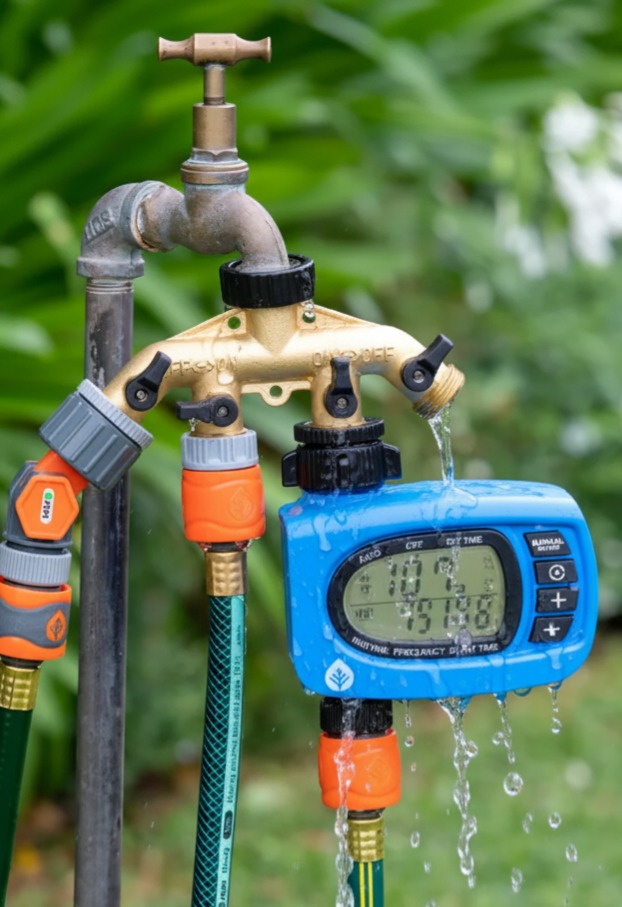
This is the ~$70 device you buy from a hardware store. It’s a simple battery-powered clock that screws onto a garden tap.
How it works: You set it to water “every 3 days for 20 minutes.”
The fatal flaw: This timer is “dumb.” It has no idea if it’s raining, if it’s a heatwave, or if the soil is already saturated. It will water at 2 a.m. in the middle of a Sydney thunderstorm, wasting water and promoting fungal disease.
2. The “Dumb” Digital Controller
This is the old, non-Wi-Fi controller often found in garage. It’s main-powered and more robust than a tap timer, but still requires manual programming for every season.
How it works: A “seasonal adjust” feature (e.g., 100% in Summer, 50% in Winter) must be changed by hand.
The fatal flaw: In reality, this never happens. Strata and homeowners forget, leaving the controller on its 100% summer schedule all year round. This is a primary source of water waste.
Smart vs. Cheap Controllers: The 10-Year View for a Sydney Property
A garden is a 10-year+ asset. The choice of controller has compounding effects over that time.
| Feature | Smart Wi-Fi Controller (e.g., Hunter Hydrawise) | “Dumb” Controller (Tap Timer / Old Digital) |
| How it Waters | Weather-based. Uses local ET data to water the exact amount needed. | Time-based. Waters for 20 minutes regardless of weather, rain, or soil moisture. |
| Water Savings | High. Typically 30-50% vs. a dumb controller. | None. Often the #1 source of water waste in a strata complex. |
| Sydney Water Rules | Fully Compliant. Smart systems are legally allowed to water at any time under the NSW Government’s Water Wise Guidelines. | High Risk of Non-Compliance. Watering with standard sprinklers is banned during set hours. Breaches can lead to fines. |
| Plant Health | Excellent. Delivers deep, infrequent watering. Prevents over-watering (fungus) and under-watering (stress). | Poor. Promotes shallow roots, fungal disease, and runoff. |
| Fault Detection | Instant. Pro models send an alert to your phone/technician if a pipe bursts or a valve fails. | None. A burst pipe can leak for weeks, costing thousands before it’s seen on a bill. |
| Adaptability | Automatic. Adjusts daily for rain, wind, and heat. | Manual. Requires 4-6 manual programming changes per year (which are rarely done). |
| Upfront Cost | Moderate (Unit: $400 – $800+). | Low (Unit: $70 – $250). |
| 10-Year Cost | Lower. Pays for itself in 1-2 years via water savings, then generates savings. | Extremely High. Wasted water, fines, and replacing dead, stressed plants. |
The #1 Risk of Cheap Timers: The “Hydrophobic Soil” Problem
In many Sydney suburbs, especially coastal areas like Coogee, Maroubra, and Randwick, the soil is predominantly sandy.
This sandy soil is prone to becoming hydrophobic, or water-repellent. This means the soil particles are coated in waxy residues, and water literally beads and runs off the surface instead of soaking in.
When a “dumb” timer runs: It dumps 20 minutes of water at once. On hydrophobic soil, 90% of this water runs off the garden bed and onto the concrete path, completely wasting the water and starving the plants.
When a “smart” controller runs: We program a “Soak and Cycle.” It waters for 3 minutes, then pauses for 10 minutes to let the water soak in. Then it waters for another 3 minutes. This critical feature breaks the soil’s surface tension and ensures water gets to the roots, where it’s needed.
For Sydney’s clay-based soils (common in Randwick or the North Shore), this feature is just as critical for preventing a “slurry” of runoff.
-
When a “dumb” timer runs: It dumps 20 minutes of water at once. On hydrophobic soil, 90% of this water runs off the garden bed and onto the concrete path, completely wasting the water and starving the plants.
-
When a “smart” controller runs: We program a “Soak and Cycle.” It waters for 3 minutes, then pauses for 10 minutes to let the water soak in. Then it waters for another 3 minutes. This critical feature breaks the soil’s surface tension and ensures water gets to the roots, where it’s needed.
For Sydney’s clay-based soils (common in Randwick or the North Shore), this feature is just as critical for preventing a “slurry” of runoff.
Real-World Experience: The Mosman Strata’s $12,000 Water Bill
This is a scenario our irrigation technicians see every week.
The Call: A large strata complex in Mosman contacted us with an emergency. Their quarterly Sydney Water bill had exceeded $12,000, more than triple the usual. The incumbent “gardener” had no answers.
Our Audit: We arrived on-site and found a 15-year-old “dumb” controller.
The Controller: It was set to water every day for 30 minutes per station, including in the rain.
The “Hidden” Leak: The controller’s old wiring had failed, causing a solenoid valve in a remote garden bed to be stuck partially open. This meant it was leaking 24/7, but it was hidden by thick Lomandra planting.
The Wrong Heads: The lawns were being sprayed by “mist” heads, which is highly inefficient. On windy coastal days (like in Vaucluse or Mosman), most of this mist was evaporating or being blown onto the building’s sandstone walls.
The Solution (The Garden Managers Fix):
We replaced the “dumb” controller with a professional-grade Hunter Hydrawise (Wi-Fi) unit.
The Hydrawise controller immediately detected the faulty valve’s high electrical draw, and we were able to locate and replace it in 30 minutes.
We retrofitted all spray zones with high-efficiency MP Rotator nozzles, which apply water in thick, wind-resistant streams.
The Result: The strata’s next quarterly bill was back to its normal level. The system now adjusts for weather, and we get an instant alert on our phones if a leak ever occurs. The upfront cost of the new controller was paid back by the water savings in a single quarter.
Sydney’s Climate Demands a Smart Response
Sydney’s climate is volatile. This is why a “dumb” timer set for “average” conditions will always fail.
We experience:
-
High Evapotranspiration: It’s not just heat. Research from the Bureau of Meteorology shows that Sydney’s combination of heat, low humidity, and wind (especially on the coast) causes massive water loss from the soil and plants (evapotranspiration). A “dumb” timer can’t account for this; a “smart” one adjusts its schedule based on this ET data.
-
Intense Rainfall: We get periods of intense rain, followed by long dry spells. A “dumb” timer waters during the downpour. A “smart” controller has a rain sensor and uses the forecast to pause its program before the rain even starts.
-
Water Restrictions: The NSW Government’s Water Wise Guidelines are now the default. These rules are complex, but they explicitly state that “smart” controllers and drip systems can be used. Using an old, inefficient system in breach of these rules is a major liability for a strata committee.
Research into smart irrigation technology, like CSIRO’s research into WaterWise platforms, consistently demonstrates that calibrating water use to real-time plant and weather needs is the key to sustainable water management. For agriculture, this saves billions; for a strata property, it saves thousands.
Your Irrigation System is More Than Just the Controller
A smart controller is the “brain,” but it’s useless if the “body” (the system) is broken. A professional irrigation service must include auditing all components.
-
Solenoid Valves: The “taps” that open and close. These fail over time and are a common source of leaks.
-
Drip Line (Sub-surface): Essential for garden beds. We check for blockages, root-crushing (common under mature Eucalypts), and ensure the pressure is correct.
-
Spray Heads & Nozzles: Must be set for “head-to-head” coverage. Misting heads should be replaced with MP Rotators.
-
Master Valve: This is a failsafe valve installed at the water meter. When the system is off, this valve is closed. This guarantees that even if a station valve fails, your system cannot leak 24/7. This is a non-negotiable for strata properties.
Frequently Asked Questions (FAQs)
1. How much water can a smart irrigation controller actually save in Sydney? For a typical property, upgrading from a “dumb” controller to a professionally installed and programmed smart controller will save 30-50% on water usage. For a large strata complex, this can be tens of thousands of dollars per year.
2. Is a smart controller difficult to use? No. For the homeowner or strata manager, it’s easier. It’s all managed via a simple smartphone app. You can see when it last watered, see the water savings, and manually start or stop a cycle from your phone. The complex horticultural programming is all done by your technician.
3. What is the best irrigation controller brand for a strata property? We professionally endorse and install main-powered, Wi-Fi-enabled controllers from leading brands like Hunter (Hydrawise) and Rain Bird. These are robust, reliable, and have the best remote management features for professional monitoring.
4. How much does a professional smart controller cost? The controller unit itself can range from $400 to $800, depending on the number of “stations” (zones) it needs to manage. Installation by a qualified technician, including programming and a full system audit, is an additional cost. However, the payback period in water savings is typically 1-2 years.
5. Do I still need a smart controller if it rains a lot in Sydney? Yes, absolutely. Sydney’s rainfall is volatile. We have very wet months and very dry months. A “dumb” timer wastes water by running during the wet periods. A “smart” controller maximises that rainfall, using its weather data to keep the system off until the soil actually needs water again. It’s designed for volatility.
6. What about hardware store “smart” controllers? While better than a tap timer, these consumer-grade products (e.g., Orbit B-hyve) often lack the robust build quality, advanced flow-sensing, and professional management features of a system like Hunter Hydrawise. For a strata or large residential asset, a professional-grade unit is essential.
7. Can a smart controller be retrofitted to my existing irrigation system? Yes. In 95% of cases, we can replace your old “dumb” controller with a new smart controller in under an hour. The upgrade is fast and uses all your existing valves and wiring. The main requirement is a stable Wi-Fi signal at the controller’s location.
Make the Smart Choice for Your Sydney Property
Your garden is a valuable asset. Your water bill is a major expense. A cheap tap timer puts both at risk.
Investing in a professionally installed smart irrigation controller is the single most effective, data-driven decision you can make to protect your landscape, save money, and ensure your property is sustainable and compliant.
The team at Garden Managers are qualified irrigation technicians and horticulturists. We don’t just “plug in a box”; we audit your entire system, understand your soil type, and program your new controller to match the precise needs of your plants.
Contact Garden Managers today for a professional irrigation audit and quote to upgrade your Sydney property to a smart water system.