Smart Irrigation Systems for Strata Properties Sydney 2026 — What Works, What Doesn’t, and What We Just Installed
We just completed a smart irrigation upgrade at a Sydney strata property using the Hunter Node BT Bluetooth controller — no mains power, no WiFi, programmed from a phone standing in the common area. Here’s what we learned and what it means for your strata committee.
✓ Hunter Node BT Covered
✓ Sydney Water Compliant
✓ 2026 Pricing
Smart irrigation systems for Sydney strata properties in 2026 are genuinely worth the upgrade — they reduce water bills, eliminate manual controller adjustments, ensure Sydney Water restriction compliance automatically, and give your garden maintenance team real-time data that makes every visit more productive. The best solution for strata common areas where mains power or WiFi isn’t available at the valve box is the Hunter Node BT Bluetooth controller — battery-powered, waterproof to IP68, and programmed entirely from a smartphone without opening the valve box. A typical strata irrigation upgrade costs $450–$1,800 depending on the number of zones and the existing system condition.
I want to start with a situation I imagine is familiar to some of you reading this. The strata committee gets a water bill. It’s higher than expected. Someone asks the garden maintenance contractor about the irrigation. The contractor adjusts the controller — manually, standing in front of a plastic box in a valve pit, squinting at the screen. Nobody is sure exactly what schedule is running. Nobody can easily check whether the system ran during the watering window or outside it. And the next time the committee asks about the irrigation, the answer is some variation of “it should be fine.”
That is an extremely common situation in Sydney strata properties. And it’s entirely fixable.
We recently completed a smart irrigation upgrade at a strata complex in Sydney’s Eastern Suburbs — replacing an ageing basic timer with a Hunter Node BT Bluetooth controller. The difference in how we manage and report on that system is significant enough that I wanted to document exactly what we did, why we chose this particular solution, and what it means practically for a strata committee that wants reliable, compliant, reportable irrigation management.
From Broken Timer to Bluetooth Control — What We Actually Did
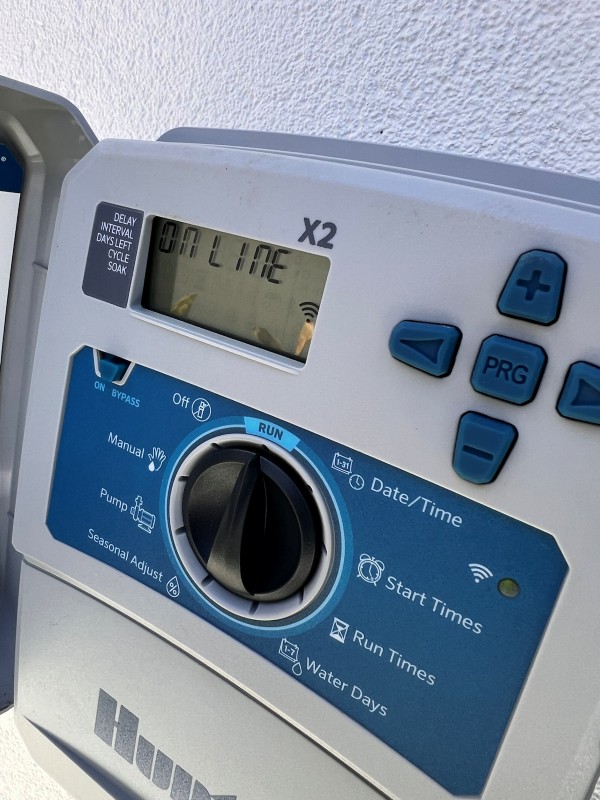
The property: a 24-lot strata complex in the Eastern Suburbs with a front garden, side garden and courtyard — three separate irrigated areas managed by a single ageing controller that had been problematic for several years. The committee’s strata manager flagged it after receiving a water bill significantly higher than the previous year. When we investigated, we found:
- The controller was running on a program set two summers ago — no seasonal adjustment had been made
- One zone had a partially stuck solenoid that was running longer than scheduled — undetected for months
- The battery backup was dead, so every power interruption reset the schedule to default (which runs at 3am — outside Sydney Water’s permitted window)
- There was no record of what schedule was running or when it had last been changed
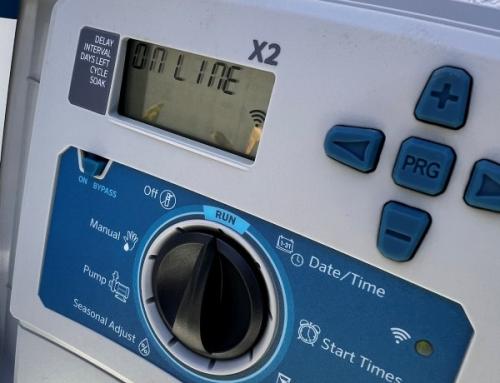
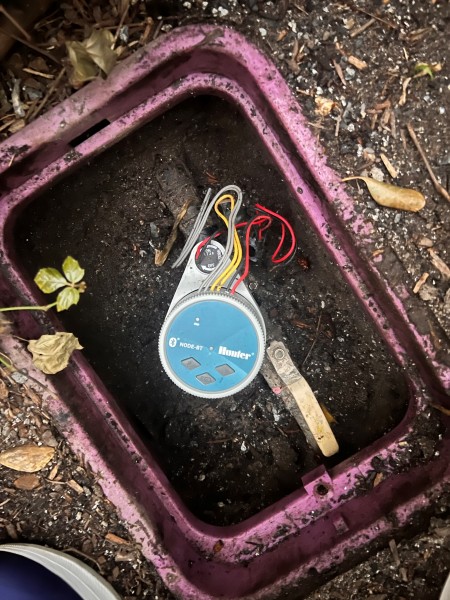
We replaced the old controller with a Hunter Node BT Bluetooth battery-powered controller mounted directly on the valve solenoids. Three units — one per zone — each battery-powered, each programmed independently from a smartphone via the Hunter Node BT app.
The result: the committee now has a documented irrigation schedule in the app. We can check status and adjust timing from the common area without opening a valve box. After every visit we screenshot the current program and include it in our photo report to the strata manager. No more “it should be fine.”
What Is a Smart Irrigation System — And What Makes It Different?
The term “smart irrigation” gets used loosely — sometimes to describe a basic digital timer, sometimes to describe a fully connected cloud-based system with soil moisture sensors and weather feeds. For the purposes of this guide, here’s a clear definition that applies to Sydney strata and residential properties:
A smart irrigation system is one that can be programmed, monitored and adjusted remotely — either via Bluetooth (like the Hunter Node BT) or via WiFi and an app (like the Hunter Hydrawise) — and that includes at least one mechanism to avoid running when moisture conditions don’t require it.
The key difference from a basic timer is not just convenience. It’s accountability. A smart controller creates a record of what ran, when, for how long, and whether anything went wrong. For a strata property, that record is the difference between a committee that can demonstrate compliant, responsible water management and one that can’t.
The Three Levels of Smart Irrigation for Sydney Properties
- Level 1 — Bluetooth battery controllers (Hunter Node BT)
No mains power, no WiFi needed. Programmed from a smartphone within Bluetooth range (up to 15 metres). Ideal for strata common areas where running cable to valve boxes isn’t practical. Records battery status, program history and run logs in the app. - Level 2 — WiFi smart controllers (Hunter Hydrawise, Rain Bird)
Connects to your property’s WiFi and manages irrigation remotely from anywhere in the world. Integrates with weather data to skip watering when rain is forecast. Full app visibility for committees and property managers. Requires mains power at the controller location. - Level 3 — Sensor-integrated systems
Adds soil moisture sensors and flow meters to a Level 2 system. Can detect leaks in real time, skip watering when soil is already wet, and log water usage by zone. Ideal for larger strata properties or commercial grounds where water costs are a significant budget item.
Most Sydney strata properties sit at Level 1 currently — or below it, with a basic manual timer. Moving to Level 1 or Level 2 is the most cost-effective upgrade available for improving water management, compliance and reporting.
The Hunter Node BT — Why We Use It for Strata Common Areas
We specify the Hunter Node BT Bluetooth controller for strata valve boxes and common area irrigation where running mains power or a data cable to the controller isn’t practical. Here’s exactly what it is and how it works.
Why It Works for Strata
The single biggest practical advantage for strata irrigation management is this: you never need to open the valve box to adjust the program.
On a typical strata property, the valve boxes are in the ground — usually muddy, sometimes flooded, always inconvenient. The old process for adjusting irrigation timing meant physically opening the box, crouching down, pressing buttons on a small controller screen in poor light, and hoping you’d programmed it correctly. There was no record of what you’d changed or when.
With the Node BT, our team stands in the common area, opens the Hunter Node BT app on a phone, connects via Bluetooth to the controller below ground, and adjusts the schedule in real time. The app logs every change with a timestamp. We screenshot the current program and include it in the committee’s photo report the same day.
For a strata committee that needs to demonstrate compliant irrigation management — this is not a minor upgrade. It’s a fundamental change in how well you can document and control your water use.
“Before we installed the Node BT at this property, our irrigation report to the committee was essentially: ‘system checked and running.’ After the install, our report includes a screenshot of the current program showing exact start times, run durations per zone, and battery status. If a strata manager is asked at an AGM whether the irrigation is running within Sydney Water’s permitted hours — they can now answer that question with documentation rather than an assumption.”
Sydney Water Compliance — Why Smart Irrigation Matters for Strata Committees
Sydney Water’s Water Wise Guidelines apply year-round to all customers in Greater Sydney, the Blue Mountains and Illawarra — regardless of whether formal restrictions have been declared. The core rule: automated irrigation systems may only run before 10am or after 4pm. Fines start at $220 for individuals and $550 for businesses. Smart controllers with rainfall override or soil moisture sensors are technically permitted to run outside these hours as they reduce total consumption — but before 10am and after 4pm remains best practice even for smart systems.
For strata properties, the compliance stakes are higher than for private residences. A strata scheme running irrigation outside permitted hours isn’t just risking a fine — it’s creating a documented breach that the Owners Corporation, as a body corporate entity, is responsible for. The $550 business fine applies to body corporate entities.
More practically: an irrigation system that has been left on a summer schedule through winter, or that has had its program reset by a power interruption, is almost certainly running outside permitted hours at some point without anyone knowing. This is extremely common in Sydney strata properties.
A smart controller solves this in two ways. First, the program is set correctly and documented — so there’s no question about what schedule is running. Second, battery-powered systems like the Node BT don’t lose their program on power interruption — because there’s no mains power to interrupt.
Many basic irrigation controllers reset to a default “safe” program when they lose mains power. On some models, that default program runs at 3am — outside Sydney Water’s permitted window. If your strata property has had any power outages and nobody has checked the irrigation schedule since, there is a meaningful chance your system has been running non-compliant hours. A smart controller audit should be a priority before the next inspection.
Is a Smart Irrigation System Worth It for a Strata Property? — The Honest Answer
Yes — but the value calculation depends on what you’re comparing against.
Compared to doing nothing
A strata property with an unmanaged basic timer is almost certainly overwatering in winter and autumn — possibly by 40-60% compared to what the garden actually needs. On a typical medium-sized strata complex running irrigation 3-4 times per week, that’s potentially $800–$2,500 per year in unnecessary water costs. A smart controller upgrade at $450–$950 pays for itself within a single year through water savings alone.
Compared to manual seasonal adjustment
If your maintenance contractor diligently adjusts your irrigation timing every season — which is what we do as part of our strata programs — the case for a smart controller upgrade is more nuanced. The primary value shifts from water saving to documentation and compliance. For a committee that needs documented proof of compliant, managed irrigation, smart controllers are still worth the upgrade.
The specific case for Bluetooth controllers in strata
The Hunter Node BT costs around $150–$250 per unit (available from irrigation suppliers across Sydney). For a three-zone strata common area, that’s $450–$750 in hardware plus installation. The investment is genuinely modest for the improvement in management capability it delivers — particularly given the ongoing water cost savings and compliance documentation value.
Need an irrigation audit or smart controller upgrade?
We assess, repair and upgrade irrigation systems across Sydney strata and residential properties. Same-week bookings available.
Do You Need WiFi for Smart Irrigation? Bluetooth vs WiFi Controllers Explained
This is the question we get asked most often when we recommend a smart irrigation upgrade. The short answer: no, you don’t need WiFi — and for many strata common areas, a Bluetooth controller is actually a better solution than a WiFi one.
When Bluetooth (Hunter Node BT) is the right choice
- The valve box is not near a power point — Bluetooth controllers are battery-powered
- The strata property doesn’t have shared WiFi in common areas — or the committee doesn’t want to give the irrigation system access to the building network
- Adjustments are always made on-site by your maintenance team — no need for remote access from elsewhere
- Budget is a consideration — Bluetooth controllers are significantly cheaper than full WiFi systems
- The installation is simpler — the Node BT mounts directly on the solenoid valve with no additional wiring
When WiFi (Hunter Hydrawise, Rain Bird) is the right choice
- The committee or property manager wants remote visibility — checking and adjusting irrigation from a phone anywhere, not just on-site
- The property wants weather-based automatic adjustment — systems that skip watering when rain is forecast or when actual rainfall has been detected
- The system manages multiple zones across a large property and centralised control is important
- Mains power is available at the controller location
“For most small-to-medium Sydney strata properties — up to about 40 lots — Bluetooth is the sweet spot. It gives the committee proper documentation and control, it costs a fraction of a full WiFi system, and it doesn’t require mains power at the valve box which is almost never available in a garden irrigation installation. For larger properties with a dedicated facilities manager who wants remote access, WiFi makes sense. For everything else — Node BT.”
Smart Irrigation Upgrade Costs for Sydney Strata Properties — 2026 Pricing
| Service / Product | Typical Sydney Cost 2026 | Notes |
|---|---|---|
| Irrigation system audit Full check, zone test, compliance review |
$180–$380 | Recommended starting point — identifies issues before committing to upgrades |
| Hunter Node BT (supply + install) Per zone, single station |
$280–$420/zone | Hardware plus installation and programming. Most strata systems have 2-4 zones |
| Hunter Node BT 2-station Two zones, one controller |
$380–$580 | More cost-effective for adjacent zones. Reduces hardware count |
| Hunter Hydrawise WiFi controller Supply + install + setup |
$580–$950 | Requires mains power. Full remote access and weather adjustment |
| Solenoid valve replacement Per valve |
$120–$280 | Often identified during audit — common on systems over 8 years old |
| Full strata irrigation service Audit + minor repairs + smart controller install |
$650–$1,800 | All-in upgrade from basic timer to Bluetooth smart system. Most strata properties |
All prices are indicative for Greater Sydney in 2026. Garden Managers provides free site assessments and fixed-price irrigation upgrade proposals for strata and residential properties.
Irrigation system upgrades are a capital works item for strata accounting — they should be funded from the capital works (sinking) fund, not the administrative fund. The ongoing annual irrigation service (checking, adjusting, seasonal programming) is an administrative fund expense. When presenting an irrigation upgrade proposal to your committee, make sure the costs are correctly allocated across both funds. Garden Managers can provide the itemised quote format your strata manager needs for fund allocation.
Irrigation Managed as Part of Your Strata Garden Program
The most effective way to manage strata irrigation isn’t a one-off upgrade — it’s integrating irrigation service into your ongoing strata garden maintenance program. Every Garden Managers strata visit includes an irrigation check as standard:
- Visual check of all sprinkler heads and drip emitters each visit
- Controller program documented in the photo report — current start times, run durations, zone status
- Seasonal adjustment at each program change (spring/summer and autumn/winter)
- Bluetooth connection to Node BT controllers to verify compliance with Sydney Water windows
- Proactive identification of leaks, stuck solenoids or failing heads before they become expensive problems
- Battery status check and replacement scheduling for Node BT units
Frequently Asked Questions — Smart Irrigation for Strata Sydney 2026
Is a smart irrigation system worth it for a Sydney strata property?
Yes — for most Sydney strata properties, a smart irrigation upgrade delivers value across three areas simultaneously. Water cost savings: strata properties with unmanaged basic timers typically overwater by 40–60% in cooler months, which on a medium-sized complex translates to $800–$2,500 per year in unnecessary water costs. A smart controller upgrade at $450–$950 usually pays for itself within one year. Compliance documentation: smart controllers create timestamped records of every watering cycle, giving committees documented proof of Sydney Water restriction compliance. Reporting: Bluetooth controllers like the Hunter Node BT allow maintenance teams to check and report on irrigation status from the common area without opening valve boxes, significantly improving the quality of irrigation documentation in committee reports.
What is the best irrigation controller for strata properties in Australia?
For strata common areas where mains power is not available at the valve box, the Hunter Node BT Bluetooth battery-powered controller is the most practical solution available in Australia in 2026. It mounts directly on valve solenoids, requires no wiring, is waterproof to IP68, and is programmed entirely from a smartphone via the free Hunter Node BT app. Available in 1, 2 and 4-zone models from irrigation suppliers across Sydney.
For larger strata properties with mains power available at the controller and a requirement for full remote access and weather-based adjustment, the Hunter Hydrawise or Rain Bird smart WiFi controllers are the leading options. Both integrate with weather data to skip watering when rain is forecast and provide full remote visibility for committees and property managers.
Do I need WiFi for smart irrigation at my strata property?
No. Bluetooth irrigation controllers like the Hunter Node BT require no WiFi — they connect directly to a smartphone via Bluetooth within a 15-metre range. This makes them ideal for strata common areas where shared WiFi is unavailable or where the committee doesn’t want to connect irrigation infrastructure to the building’s network. Adjustments are made on-site by your maintenance team using the Hunter app, with all program changes logged automatically.
WiFi controllers (Hunter Hydrawise, Rain Bird) are the better option if you want remote access from outside the property — checking and adjusting irrigation from anywhere — and if you want automatic weather-based adjustment. They require mains power at the controller location.
Can smart irrigation detect leaks at a strata property?
Basic smart controllers including the Hunter Node BT do not automatically detect leaks — but they significantly improve your ability to identify them. Because every run cycle is logged in the app, unusual patterns (a zone running longer than scheduled, unexpected pressure drops, unexplained water consumption) become visible in the data rather than invisible. More sophisticated systems with inline flow meters — typically a Level 3 upgrade — can detect leaks in real time and alert the property manager automatically.
For most Sydney strata properties, the most practical leak detection method remains a regular irrigation service visit where an experienced technician runs each zone and inspects the system physically. Garden Managers includes this as part of our standard strata garden maintenance visits.
What are the Sydney Water rules for irrigation at strata properties in 2026?
Sydney Water’s permanent Water Wise Guidelines apply year-round to all strata properties in Greater Sydney, the Blue Mountains and Illawarra. The core rule is: automated irrigation systems may only operate before 10am or after 4pm. Run-off onto footpaths, driveways or gutters is prohibited. Fines for non-compliance start at $550 for body corporate entities (businesses).
Smart controllers with rainfall override or soil moisture sensing capabilities are technically permitted to operate outside these windows as they are classified as water-reducing systems — but before 10am and after 4pm remains best practice. Any strata property with an older basic timer should audit the current schedule to confirm compliance, particularly after any power outages that may have reset the program to a non-compliant default.
How much does a smart irrigation upgrade cost for a Sydney strata property in 2026?
A complete smart irrigation upgrade for a typical Sydney strata property costs $650–$1,800 in 2026 — covering an initial system audit, Hunter Node BT Bluetooth controller installation (per zone), solenoid valve replacement if required, and full programming and documentation. Individual Hunter Node BT units cost $280–$420 per zone for supply and installation. A two-zone Bluetooth system for a small-to-medium strata common area typically costs $550–$850 all-in.
For strata accounting, the upgrade hardware and installation is a capital works (sinking) fund expense. Ongoing annual irrigation servicing is an administrative fund expense. Garden Managers provides fixed-price itemised quotes in the format your strata manager needs for fund allocation.
Ready to Upgrade Your Strata Irrigation in Sydney?
We provide free on-site irrigation assessments and fixed-price upgrade proposals across Greater Sydney. Faster turnaround in winter — book now before the spring rush.